
An in-depth analysis of the environmental impacts of single-use technology and stainless steel systems in pharma and biotech manufacturing.
Read More
It’s not enough to set ambitious sustainability goals—achieving them requires a concrete plan. Moving towards zero carbon doesn’t happen by chance. Any organization aiming for zero carbon or net-zero targets within a specific timeline needs a clear, actionable sustainability roadmap to reach these milestones.
What is a sustainability roadmap?
A sustainability roadmap is a detailed, step-by-step guide that outlines how a company can meet its sustainability targets over time. Also referred to as a sustainability masterplan, this roadmap includes everything from site-level equipment upgrades to high-level budget planning. It identifies your current carbon footprint, water usage, and waste levels, and it establishes a structured, data-driven path to meet your sustainability goals on time. With a broad scope, a sustainability roadmap covers equipment lifecycle, regulatory compliance, resource needs, and growth opportunities, creating a long-term strategy that aligns with your Environmental, Social, and Governance (ESG) goals.
Why you need a sustainability roadmap
Without a roadmap, even the best intentions can falter. A robust sustainability roadmap supports your long-term goals, such as:
- Eliminating Scope 1 emissions across all facilities by 2035
- Achieving a zero-carbon manufacturing campus by 2040
- Reaching zero waste to landfill by 2028
- Reducing water use by 30% from a 2018 baseline by 2026
Carbon neutral vs. net zero carbon: A quick overview
Understanding the difference between carbon neutral and net zero carbon is key to your sustainability roadmap:
- Carbon Neutral: You may use renewable energy credits to offset emissions, compensating for fossil fuel consumption.
- Net Zero Carbon: This involves eliminating fossil fuel use on-site through energy efficiency, electrification, and renewable energy sources.
Check out a full list of sustainability terms.
Who to involve in the development process?
Collaboration between teams is necessary for success. Input from the facility manager, technicians, the safety team, and those who operate the building management system is instrumental in creating a successful sustainability roadmap. These are the people who understand what works and what doesn’t within your buildings. Likewise, involvement of the C-suite is important for a number of reasons, not least of which is to champion major CapEx budgets and understand how operational changes fit into the overall business strategy. Executive involvement also demonstrates the importance of sustainability and signals that suggestions for operational improvements are welcome if they help meet sustainability goals. Communication with operational staff helps executives understand the need to dedicate time, resources, and energy to maintain systems to mitigate risk, such as downtime due to a lack of scheduled maintenance.
How to use a roadmap to advance your sustainability goals
A sustainability roadmap provides ongoing guidance across four key phases:
- Use your roadmap for next year’s capital planning efforts. Identify the top priorities for that year and get your funding approved.
- Use as a guide for writing your RFP requirements.
- Several ESG reporting organizations require benchmarked utility data to be disclosed, and corporate leadership is often pushing for year-over-year improvements. A sustainability roadmap will include this information for easy reference and use elsewhere.
- Make adjustments to your sustainability roadmap on a two or three-year cycle as technology improves and projects are implemented.
Applying a sustainability roadmap to biotech and pharma
With its focus on enhancing healthy communities, the biopharma industry knows that addressing climate change is critical to global well-being. Most large companies have established zero carbon goals and are committing to 3rd party initiatives, like science-based targets (SBTs), to hold the earth’s warming to no more than 1.5 Celsius and require companies to meet zero carbon no later than 2050. Meeting these kinds of targets will take planning, coordination, and foresight, especially when it comes to reducing emissions within existing facilities and operations.
Biopharma companies leverage sustainability roadmaps for guidance when:
|
|
While your production focus may shift as new classes of drug products arise—for example, cell and gene therapies, mRNA vaccines, and antibody-drug conjugates—sustainability roadmaps address systems common within building systems or envelopes. Manufacturing facilities include systems that are uniform across industries, such as lighting, HVAC, compressed air, purified water, and steam. A roadmap looks at how to integrate these systems into a new or existing building. In a facility expansion, it also explores how to incorporate additional equipment or processes while maintaining the optimization of existing systems or scaling them in a manner that doesn’t impact sustainability.
Benefits of a sustainability roadmap
CapEx and OpEx savings
Historically, sustainability measures were viewed as an added expense without an obvious return on investment. These days, sustainability can be integrated strategically and economically. This becomes especially true when the project is guided by a plan developed by an experienced team familiar with the technologies and tools available to you.
- CapEx savings: Not only are there federal and regional tax incentives that help shoulder the capital cost of sustainable infrastructure, like adding solar panels, but there are also community choice programs and power purchasers’ agreements to help with these investments. The benefit of generating your own on-site clean energy is not just reducing your carbon footprint but also resiliency from grid outages and volatile utility prices, and reduced overall energy costs.
- OpEx savings: Within operations, we’ve seen dramatic savings when set against the operating costs of a standard code facility, equating to millions of dollars saved per year. Tools like energy models can help you compare equipment replacement options to identify the lowest energy user over its expected useful life. At CRB, we work with our utilities and automation engineers to optimize cooling tower systems, process engineers to optimize cleaning cycles, and warehouse teams to optimize space and materials—all of which contribute to reduced OpEx.
Site-level benefits
Site management and procurement teams can consult your roadmap to help plan for scheduled end-of-life equipment needs. And when something breaks, an operator can consult your roadmap for guidance to swiftly find replacement equipment that furthers the company’s progress rather than mistakenly sets it back. Providing quick and confident decision-making empowers your site-level team to work within what can sometimes be murky corporate direction.
Sometimes, direction from management can seem conflicting—should your team keep costs low or source low-energy equipment? The roadmap helps here, too, by presenting your team with an easy way to identify priorities or the middle ground.
Improved customers and investor relations
Companies are embracing sustainability to maintain market share, connect with consumers, and improve brand reputation. In fact, the Dow Jones Sustainability Indices rate companies based on their steps to reduce climate and environmental impact. So, simply saying you’re “green” is not enough; quantifiable action is needed.
Companies are becoming more transparent, publishing progress on sustainability targets, utility use and annual emissions through 3rd party programs like SBTi and the Climate Disclosure Project. While a sustainability roadmap is not intended to be a public-facing document, it does provide an engineering and implementation plan, ensuring real progress can be made and reported on for your public disclosures.
How to create a sustainability roadmap
CRB’s sustainability consultants use a defined, five-step process to build effective sustainability roadmaps:

- Confirm goals with a sustainability charrette
- Benchmark current performance
- Analyze technical solutions
- Analyze cost-benefit and financing
- Develop a timeline and milestones

1. Confirm your goals early with a sustainability charrette
A sustainability charrette establishes the project’s conditions of satisfaction—the key metrics for the project with specific timelines for accomplishing them. Alignment from the outset on these conditions of satisfaction from the client, internally, and with the project team is critical to ensuring a plan’s success. This alignment clarifies:
- The client’s definition of zero carbon
- Whether the plan assumes zero on-site combustion or includes plans for biofuels, such as renewable natural gas or hydrotreated vegetable oil
- Whether natural refrigerants are required or if there’s an acceptable global warming potential
- Whether zero carbon is limited to normal operations or if backup power needs to be decarbonized as well
Here’s our sustainability charrette template to help you get started.

2. Benchmark current performance
CRB’s sustainability team reviews specific data to establish current performance against the sustainability goals. This includes utility bills, utility trend data, and a site equipment list, which the team uses to assess the current state of performance towards goals. For a zero-carbon roadmap, this also includes a carbon compliance inventory review, which looks at all carbon-contributing equipment, system by system. For a water evaluation, this includes a site or building water balance, identifying and quantifying all users and waste streams.
Depending on the data already available from a client’s enterprise asset management system, CRB uses an equipment lifecycle utilities assessment to incorporate the site equipment lists into an equipment assessment report, with estimated useful life, remaining useful life, and conditions assessments to inform the state of the site and inform capital planning.

3. Analyze technical solutions
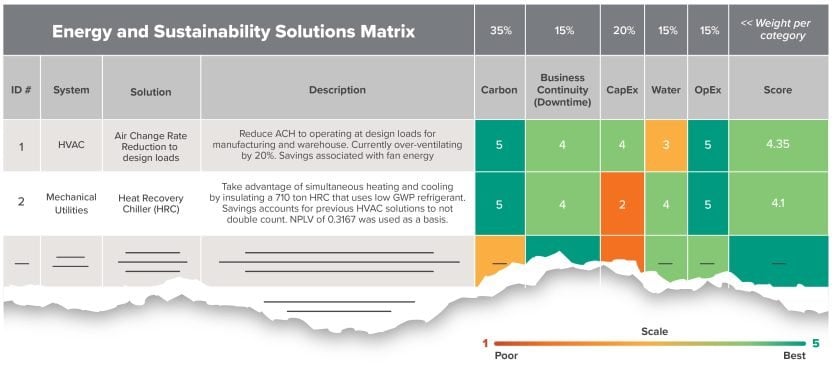
Using information on the current state and systems, our team of sustainability consultants work with the client’s key stakeholders to ideate sustainability solutions, informed by the >250-item energy and sustainability solutions matrix. For a zero-carbon roadmap, this will include energy conservation measures and best available technologies for addressing systems contributing to scope 1 carbon emissions and energy use, on-site or local renewable energy, and storage solutions.

4. Analyze cost-benefit and financing
Our sustainability team then evaluates by assessment criteria to inform the selected solutions for the roadmap. Criteria of the evaluation may include:
|
|
The evaluations may also include a choosing by advantage assessment of the best available technology to address a particular path forward. An example is the type of heat pump to include in the central plant, such as air-water, air-water-water, ground source, heat recovery chiller, or some combination thereof.

5. Develop timeline and milestones
Informed by the analyses of the energy and sustainability solution measures, CRB develops a recommended project list and a step-wise implementation approach to meet and exceed the goals by the target year. Our team takes into account shutdown schedules, site resource availability, existing capital plans, and more.
Detailed timelines allow facilities to plan for sustainability projects within existing planned shutdowns and schedule projects around times when existing, energy-intensive equipment needs to be replaced. This includes a plan for when equipment fails, so you’re not replacing it in kind but rather with the best available technology to meet your long-term goals. Alternatively, a recently installed piece of equipment is low on the priority list for replacement, allowing the site to realize its full value before replacing it with a green alternative.
Achieving zero carbon can require significant capital investment to meet the acceleration of zero carbon goals and the immediacy of the global health crisis of climate change. To maximize efficient use of capital funds, the timeline for the roadmap is informed by the equipment assessment so that each recommended project in the roadmap is tied to an implementation schedule determined by the remaining useful life, observed condition, and importance of each piece of existing equipment. With equipment remaining useful life considerations and understanding capital plans already in place for updating equipment, zero carbon plans can be implemented while minimizing the associated marginal cost. Significant expense is incurred when recently installed equipment is replaced to reduce carbon emissions; this makes it critical to ensure all future investments align with zero carbon goals.
Getting started with your roadmap
Starting a sustainability roadmap can be overwhelming, but CRB’s experts are here to guide you. With extensive experience in biopharma and other industries, we understand how to reduce emissions and optimize utility usage while complying with cGMP regulations. A well-crafted sustainability roadmap can help you achieve zero carbon goals and make measurable, impactful strides toward a more sustainable future.
Our dedicated sustainability consultants can help you meet your goals and KPIs. Let’s talk.
Frequently asked questions: Developing your sustainability roadmap
If your organization has corporate or site-level goals to eliminate or reduce energy, waste, water or carbon, you need a sustainability roadmap to get there. This is because many of these tasks are not quick fixes, like scheduling when boilers or other big combustion equipment will reach their end of life or including additional time for grid interconnection after adding a renewable energy source. Your sustainability roadmap outlines the big and small steps needed on a realistic timeline to help avoid missteps along this multi-year undertaking.
To start a sustainability roadmap, site benchmark data, submeters (or a plan to install submeters), clear energy, waste and water goals, equipment useful life assessment and leadership buy-in. When working with a consultant, they will often start with a sustainability charrette to help gather and understand each of those aspects and their role in the roadmap.
To start a sustainability roadmap, you’ll need at least 24 months of site energy and water use for basic benchmark data. Better yet, if you have sub-metered data on high-energy and high-water-use equipment and processes within that site.
Your roadmap will only work if you have leadership buy-in.
You should regularly revisit your sustainability roadmap in two ways: First, you should report incremental progress quarterly or by-annually to an oversight committee; Second, you should reevaluate the roadmap itself every 3 years to account for technological advancements and regulatory changes.
High ROI, low emissions: The heat pump advantage for biopharma
Examples of why biopharma is making the switch to heat pumps from traditional gas-fueled heating systems
Read More
Planning sustainable building designs with sustainability charrettes
A step-by-step planning guide to achieve your building’s sustainability goals with a sustainability charrette.
Read More