Return to top


Site planning and facility design are crucial initial steps in new development. At the beginning of the project, it’s important to define priorities, goals, and objectives. In our experience, you’ll make 90% of the decisions for the facility’s lifespan in the first 10% of the project. Efficiency, employee satisfaction, and long-term flexibility are all considerations during initial design and planning that will play out over the next 20-30 years of a facility’s lifetime.
But what happens as you move from the design’s perfection to the realities of construction on a greenfield or brownfield site?
Understanding greenfield vs brownfield sites
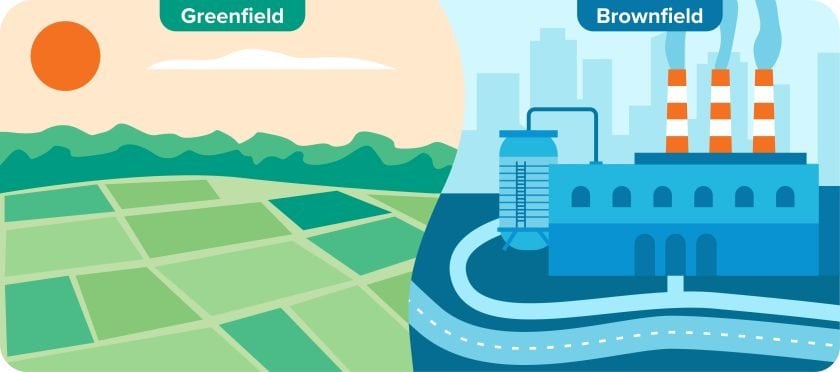
Greenfield and brownfield projects are often mistakenly seen as entirely distinct. In reality, it’s more of a spectrum. A greenfield site indicates a new build in a location with no existing facilities, utilities, or buildings. In contrast, brownfield developments can include a range of scenarios, from empty lots with available utilities, new prefabricated buildings, structures repurposed for a new process, or new lines next door to your existing operations.
Key drivers: geography and timing
Elements early in planning, higher up the decision tree, always define the site location. The project’s business case will front-load high-level decisions related to any kind of capital delivery project. What are its conditions of satisfaction and timeline or budgetary constraints? Before considering specific sites, conduct a site-agnostic baseline study to help identify hidden constraints and potential surprises from the very beginning.
In our experience, there are two key drivers that end up shaping the decision on whether a development should be greenfield or brownfield:

Geography
Sometimes a specific geographical location is simply non-negotiable. Your facility needs to be close to a unique talent pool (otherwise they’ll just work for your competitors). You want to be close to a particular cluster, such as biotech in California, gene and cell therapy in North Carolina, or food production in New Jersey. The local government is offering helpful tax incentives. Perhaps you need a particular transportation hub or source of raw materials. Sometimes the solution starts with simply drawing a circle around a spot on the map and finding all the options within it.

Timing
Markets move fast, time is money. Companies often see brownfield projects as a path to quick increases in capacity, taking advantage of utility hookups or shell structures. But without robust planning and risk mitigation, there’s no guarantee that these pre-existing assets will accelerate delivery. Brownfield developments can carry more variability and uncertainty, potentially taking longer and costing more than expected.
Greenfield developments: flexibility and innovation
Greenfield sites offer maximum flexibility and opportunity. You can design with an open mind, optimize everything, and bring new products to market with innovative layouts and construction methods. Facilities with the newest technologies and materials are typically less costly to maintain. Manufacturers planning large facilities with high power and water requirements, for example, often choose greenfield sites.
Strong interest in greenfield sites
Throughout history, we’ve seen interest in greenfield sites across many industries driven by unique opportunities and ambitious goals. In food and beverage products, we see this in increased demand for alternative proteins, meeting production and sustainability goals, or scaling to meet new market demands. In pharmaceuticals, it can be innovative blockbuster drugs: cell and gene therapies (CGT), coronavirus vaccines, GLP-1 therapies for obesity and diabetes treatments, and new targeted therapies.
Building from the ground up
When planning a greenfield development, you need to build the structure, connect the utilities, and equip the building for operation. This typically increases the time and cost of starting production due to feasibility studies, local regulations, and other hurdles associated with new site development projects.
Meati’s 100,000+ square-foot greenfield “Ranch” facility leverages a vertically integrated approach to grow, harvest, process and package products under one roof.
Addressing unique challenges
Greenfield developments often involve addressing unique challenges. For instance, can the town provide the utilities (water, electricity, waste management) you need without overstressing local infrastructure? Both life science and food and beverage manufacturing are water-intensive and can produce wastewater that needs extra treatment, e.g. monoclonal antibody facilities can use up to 1,000,000 gallons a day. Processes involving flammable liquids require large, powerful sprinkler systems, putting tremendous demands on the local water infrastructure.
It’s not just water–production facilities are energy-intensive. Even after defining the basic electrical loading, further investigation may reveal that the connected electrical utility cannot provide the necessary power for full production, requiring upgrades much further up the power transmission line. Despite their larger initial investment, greenfield designs often include energy-saving options that lead to long-term savings in operating expenses.
Setting sustainability goals
Every large construction, renovation, or design project should have sustainability goals. This includes reviewing local industry and policy trends, established corporate sustainability goals, and aligning with regional priorities to inform project-specific priorities and metrics. You can preserve your goals through design, construction, and operation, accommodating future expansion or retrofits with effective planning.
Location considerations
Location is crucial for greenfield developments. Even if we have the power and water resources needed, other capacities may require buildout, taking time that may not have been properly addressed in initial planning efforts. A remote or rural location can delay getting materials on-site, impacting supply chain management and raw material storage.
Manufacturing facilities often require specialized trades to install and service equipment, potentially necessitating a premium for their services. Skilled electricians, welders, carpenters, and plumbers are in high demand. Delays in materials or labor shortages (due for example to a remote project location) can create added costs and logistical bottlenecks, the true enemies of on-time, on-budget project delivery.
CRB’s Quarterly Market Conditions Report evaluates current material lead times and labor availability.
Involve experts early in the site selection process to uncover hidden constraints and costly surprises before finalizing a site decision. Bringing design, construction, and automation control systems SMEs to collaborate on the initial concept phases can help you fully understand the consequences of a given site selection.
Attracting the right talent
The location of your greenfield development can create challenges beyond construction. Can you attract the right talent? Without them, we’ve seen facilities fail to maximize their investment return. The good news is that a cutting-edge, clean, new facility can help attract and retain employees. Features that align with LEED and WELL certification criteria, such as outside views, acoustic and thermal comfort, optimized lighting, and more, can help build and retain a committed workforce. Local governments may offer incentives for building capacity and training new employees, as they often seek to bring new economic activity into their jurisdictions.


Mars Chocolate North America’s 500,000-square-foot Topeka facility included important sustainability features, including a state-of-the-art heat recovery system and rain-harvesting for irrigation and sewage transfer, all while reusing and recycling building materials. It achieved its “zero waste to landfill” goal and Food Engineering magazine named it 2015’s Plant of the Year.

Mycotechnology’s 86,000-square-foot mushroom fermentation plant in Aurora, Colorado, had a vertical building design that decreased the plant’s gas and water consumption, saving over one million gallons of water a year and reducing natural gas usage by 40%, earning the company Food Engineering magazine’s Sustainable Plant of the Year in 2020.

Takeda’s 1.1-million-square-foot plasma fractionation facility near Covington, Georgia is the cornerstone of its global strategy to ensure worldwide delivery to patients through an integrated network that includes plasma donor centers, plasma testing laboratories and manufacturing facilities in multiple countries.

Brownfield developments: speed and cost efficiency
Under the right circumstances, brownfield development can significantly speed up the creation of new capacity. Expanding an existing facility or purchasing/leasing an existing building can quickly meet demand for established products and provide a competitive supply advantage. Retrofitting a building may also reduce capital requirements, enabling near-term capacity for in-demand products.
A key benefit of brownfield sites is the ability to bypass lengthy feasibility studies and immediately scout buildings compatible with your business model and production processes. Often selected because they are already constructed, these sites can lower startup costs and construction time. Additionally, if local governments require licenses and approvals, brownfield facilities may already comply with some regulations, particularly if the facility previously supported a similar production process.
Benefits of brownfield sites
Potential for reduced startup costs and time: You can bypass extensive feasibility studies and begin scouting buildings compatible with your business model and production processes.
Pre-existing compliance: If local governments require licenses and approvals, brownfield facilities may already comply with some regulations, especially if the facility previously supported similar production processes.
Strategic location advantages
Brownfield sites are often in desirable locations – by definition, someone has already wanted to be there. Being able to locate your facility in an urban center can have huge advantages.
- Urban centers: Brownfield sites are often in desirable locations, such as urban centers, offering significant advantages like proximity to talent pools, suppliers, partners, and customers.
- Localization benefits: Being local can be crucial in industries like pharmaceuticals, where products like radiopharmaceuticals, or personalized cell and gene therapies need to be produced close to hospitals for quick delivery to patients.
- Location benefits: Despite potentially higher costs for remediation (e.g., asbestos, or chemical contaminants), the strategic location might justify the investment.
- Sustainability goals: Retrofitting an existing building aligns with sustainability goals by minimizing new land development, reusing existing infrastructure, and reducing waste.
Challenges and limitations
While brownfield developments offer numerous benefits, they come with risks. Unexpected complexities can delay schedules, preventing them from delivering on their promise of being faster or less expensive than a greenfield development. An existing facility may require adjustments based on its current design, such as dealing with lower-than-desired floor-to-floor heights or limitations on improvements in leased properties.
- Infrastructure constraints: Essential infrastructure like large generators for emergency power, water, and gas services might not be present. Upgrading these can be challenging and may not align with your desired timeline.
- System surveys: Older facilities might lack up-to-date engineering designs, hiding gaps in the infrastructure and leading to more uncertainties.
- Utility costs: The cost and capacity of utilities are critical. For instance, processes like extruding plant-based protein require significant steam, electricity, and HVAC for exhaust steam. Even minor changes can make a difference as utility companies charge based on peak levels of energy use. Reducing resource consumption can save costs, such as by harnessing byproduct steam or energy from existing systems.
- Regulatory approvals: Previous approvals for similar products may not be transferable, leading to new regulations and major renovations.

The North Carolina Food Innovation Lab (NCFIL) is a one-of-a-kind plant-based food innovation. Through an integrated design and construction strategy, the space was retrofitted for product development, research, and quality assurance labs, CGMP rooms, processing areas, collaboration spaces, cold storage and equipment storage.

At BioLabs in Dallas, the 37,000-square-foot facility is on one floor, offering easy access to the loading dock that meets all its tenants’ needs, including managing the movement and storage of hazardous chemicals and waste.
The growth of plant-based meat options has some manufacturers looking to switch from refrigerated to frozen applications, which can be complex and costly in brownfield scenarios.
Common elements of greenfield and brownfield developments
No matter how thorough your planning or excellent your design, changes during construction may be inevitable. Initial surveys and reports might omit unforeseen crucial details, material prices may fluctuate due to outside influences beyond the project’s control, and local laws could be amended. Understanding the potential challenges and opportunities of each type of project is crucial for success.
Navigating unexpected challenges
Unexpected challenges can arise in any project. For example, one site located in an earthquake-prone area required additional structural support. As we started drilling pilings, we discovered old batteries, automobiles, and other objects buried underground, indicating an old landfill. To protect the facility, we had to add vapor barriers, ventilation, and secure the foundation against groundwater contamination.
In another case, we found a beautiful plot of land with existing buildings, ideal for a facility. However, it was adjacent to a creek known to be contaminated by nuclear waste from WWII efforts. These kinds of discoveries can demand significant adjustments to project plans.
Existing buildings planned for brownfield redevelopment need careful inspection to ensure they do not require major renovations, such as asbestos mitigation and upgrades to electrical systems.
Fortunately, there are many ways to handle the unexpected. Approaches like integrated project delivery (IPD) will merge design and construction activities to maximize communication and minimize rework and misunderstandings that can happen at sequential handoffs.
Sometimes outside expertise can find creative facility improvements or process optimizations that you didn’t know were possible. For example, we’ve seen manufacturers of cultivated meat or even pet food benefit from a project delivery team with extensive experience designing highly efficient, safe, and GMP-compliant facilities for the biotech industry.
Economic considerations
Companies view greenfield versus brownfield developments as economic investment choices. Evaluating the economic returns from various financial levers—such as one-time investments, tax benefits, local incentives, ongoing costs, and the benefits and risks of manufacturing in a specific location—is essential for aligning with the company’s operating strategy.
Approach your capital investment with confidence
Navigating the complexities of brownfield or greenfield facility development requires strategic planning, collaboration, and a commitment to adaptability. By considering the key points outlined above, you can ensure a successful and cost-effective project outcome.
It’s never too early to talk. If you are even considering a new facility, one of the best ways to ensure success is to work with experts who can synthesize your business plan, manufacturing needs, and vision for future expansion into a tailored checklist that’s detailed, flexible, and specific to your unique situation.
Reach out to learn how our specialists can help you approach this process with confidence and find a site that will serve the project today and far into a successful future.


An introduction to ATMP manufacturing
How the ATMP and cell and gene therapy industries can prepare to scale manufacturing operations safely, sustainably, and strategically.
Read More