
Food safety demands careful planning and diligent execution across various stages of food processing, spanning from product inception and scaling to facility design, construction and operations. Following is an essential guide outlining key considerations vital to understanding and upholding food safety standards in your food processing plant.
Approximately 48 million Americans become sick from consuming contaminated food and beverages every year. This is costly, not only in terms of impact to human health and wellbeing, but it can also lead to expensive food recalls and damage to brand reputation.
The good news is that food manufacturers and regulators take food safety seriously, as evidenced by the drop in USDA food recalls, which have been almost cut in half since 2019. And, as found in our surveys of food manufacturers, there is a willingness to invest in upgrades to facility hygiene procedures that improve compliance and enhance food safety.
Food manufacturers must consider how any change in formulation or processing will affect food safety when developing products. These concerns are carried through the scale-up process, facility design, raw material procurement, storage, production and final product distribution. To keep food products safe, it’s critical to account for and document all risks in a food safety plan.
Learn how to successfully build a culture that encourages and reinforces food safety, lay out important elements of plant and equipment design and create a food safety plan that ensures the production of safe products.
Food safety resources
Click the below links to jump to helpful food safety resources:
Developing a comprehensive food safety strategy
A robust food safety strategy is crucial in food manufacturing, not only ensuring compliance with regulations but also protecting consumers from potential health hazards and solidifying your brand promise. Here are five recommendations to create a comprehensive food safety strategy.
1. Build a strong foundation
Before beginning any operations, there must be an effort to ensure that food is kept from all hazards that could make consumers sick. Attention must be focused on several aspects to create a facility and culture that help maintain food safety, among those:
- Facilities design and construction, including the grounds, building and sanitary facilities
- Personnel hygiene and training
- Sanitation standard operating procedures (SOPs), chemical control and pest control
- Recall procedures and product traceability program
- Operational practices, including allergens and foreign material control
- Transportation, supplier verification, supply chain logistics and warehousing
2. Leverage a risk-based approach for your food safety plan
To minimize all possible risks that might contaminate a food product, it is necessary to take a risk-based approach to food safety. A risk-based approach involves assessing and prioritizing potential food safety hazards, whether biological, chemical, or physical, and then implementing controls to minimize or eliminate these risks at critical points. The Food Safety Modernization Act (FSMA) outlines how to make a risk analysis and establish preventive controls (PCs), quality controls (QCs) and critical control points (CCPs) that are easy to monitor.
A robust food safety plan should account for end-to-end production of your product and needs to be signed by the manager or president of the company. Having such a plan provides control points that internal staff can monitor, validate and document.
3. Develop a HARPC system
The Hazard Analysis and Risk-based Preventive Controls (HARPC) is a systemic preventative approach to controlling significant food safety hazards. It focuses on ensuring that risks are controlled throughout the process and not just in the last step of production.
After a thorough analysis of the possible risks that can contaminate the product, the producer determines a series of actions to prevent and control contamination from microbes, dust, chemicals and extraneous material in small steps (preventive controls) which include transportation, storage conditions, handling, etc. These actions are to be monitored and documented.
4. Defend against intentional adulteration
Your food safety plan needs to include processes to prevent the purposeful contamination of food products meant to cause widespread harm. Guidance and regulations for such a food defense plan are codified in FSMA’s Final Rule for Mitigation Strategies to Protect Food Against Intentional Adulteration. As part of its food safety oversight, the FDA undertakes vulnerability assessments on food systems to identify the key types of activities that introduce risk.
Examples of areas within a facility that are vulnerable to intentional adulteration include:
- Ingredient bulk storage tanks – The vulnerability of being outside, easily accessible and unprotected can be minimized by using fences to protect materials, having ingredients under lock and key, relying on cameras to monitor areas and limiting access to authorized personnel in sensitive areas.
- Warehouse delivery areas – Delivery drivers can be granted access, using methods such as a key code, to the warehouse or storage areas when delivering and unloading product. To restrict the production facility to employees only, facilities will often include a separate receiving office and bathroom.
5. Leverage automation and integration
There is a trend throughout manufacturing to embrace the concepts and technologies of Industry 4.0. Control systems integration can greatly reduce the chance of human error and improve food safety. Having integrated systems helps minimize risks at every step, from warehousing to formulation to production. Besides, the use of automatic records, and even better electronic records (21CFR11), ensures that all processes are monitored and documented. In addition, the benefits of automation extend to formulation, where it can help prevent the addition of excess nutrients, or accidental inclusion of allergens, both significant causes of recalls.
Automation also provides benefits far beyond food safety, including optimizing processes and sustainability by optimizing the water and energy use.

Establishing a culture of food safety
An established food safety plan is only as good as the company culture in which it is applied. Even the best-laid food safety plan will fall apart if the human element isn’t taken into account. It’s critical your company leaders prioritize food safety, consistently communicate your policies, allot proper resources and lead by example. Personnel needs to be continuously trained in GMP, SSOPs, etc. Regular training fosters employee engagement, reduces human errors that can lead to food safety gaps, helps raise awareness of vulnerabilities and reduces the risk of intentional adulteration. At a minimum, food safety training should occur at least once per year.
Food safety training should be like a dripping tap. The steady drip, drip, drip of information and reminders prevents complacency. You may not have had a safety issue for years—that doesn’t mean there isn’t one brewing.
Beyond this, there are additional ways food safety is ingrained in a company culture once you have food safety and defense plans in place.
Conduct food safety assessments
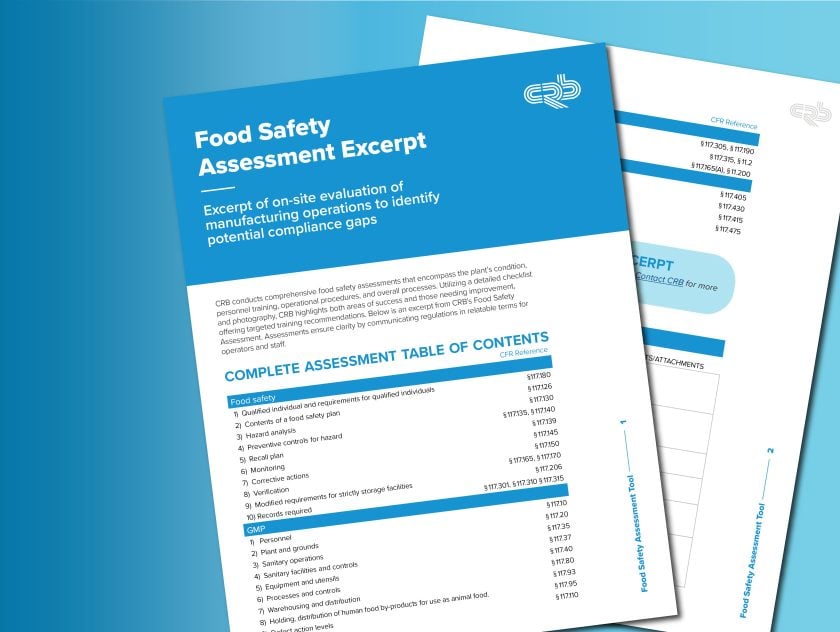
Food safety assessments are on-site evaluations of manufacturing operations to identify potential compliance gaps. When conducting a food safety assessment for a client, we evaluate the state of the existing plant, training and qualifications of personnel, operations and process. We present the regulations in language that the operators and staff can relate to, complete a detailed checklist, take photos and identify what is being done correctly and what areas need improvement. This full assessment can occur before or after you have a food safety plan. It allows customized training of employees, using examples of gaps based on their plant and their equipment.
There are a couple of problem areas that commonly arise during assessments:
Maintenance of equipment and plant
Preventative maintenance is imperative to ensure food safety. Besides regular calibration of sensors and measurement devices, all equipment should be maintained in set intervals. Maintenance by failure can create problems, especially when you are caught off guard when a piece of equipment fails. Maintenance protocols include ensuring staff entering food prep areas have clean shoes and tools are segregated in high-care areas. Maintenance should not occur without proper segregation while the plant is operating.
Facility organization
This refers to the flow of materials and personnel. If a facility is not organized properly or protocols are not followed, it’s possible to track dirt and other contaminants from one area to another. It’s easy to overlook sanitation risks in the production area, such as storing cardboard, which can contain a high load of microbes.
Create an audit plan
Food safety audits are conducted by regulatory agencies, like the Food and Drug Administration (FDA) and the US Department of Agriculture (USDA), usually once each year. During an audit, inspectors must be given access to the entire facility, as well as records and documents.
The best way to prepare your facility and team for an official audit is to have a food safety consultant perform a pre-audit. This can be an external consultant—like CRB—or an internal expert. Some large companies separate their food safety department from production. This way the consultant lacks ties to the plant and is able to maintain a more critical eye toward the food safety audit. Consider conducting pre-audits during the third shift, when there isn’t usually managerial staff.
Be prepared for a food recall
Fortunately, the number of Food Safety and Inspection Service (FSIS) food recalls in 2022 (69) declined dramatically compared to 2019 (131). Still, they do occur. For example, nine dog deaths in Brazil led to a recall of dog snacks containing ethylene glycol in 2022. In North America, food recalls are based on CCP failures that result in the addition of excess nutrients, undeclared allergens, or due to microbial contamination. FSIS can issue a company’s voluntary recall when meat, poultry, or eggs are adulterated or mislabeled.
Test your food safety plan’s ability to prevent a recall by conducting a “mock recall.” A mock recall will provide an opportunity to verify the food recall procedures in place are effective and all records and documentation are complete and accurate. This should include complete traceability of ingredients to final products, preferably using digital technologies. Being able to respond quickly may be a matter of life or death. Prompt action can prevent the recalled material from getting into the hands of consumers, and often, the sooner a recall is initiated, the less costly it will likely be.
Even food manufacturers with the most stringent protocols can face a food recall. Be prepared – review CRB’s food recall guide for manufacturing and processing facilities.

Food safety practices in hygienic facility design and construction
Having a well-developed food safety plan and establishing a culture of safety are essential to success. Furthermore, food safety needs to be designed and built into new, expanded or renovated facilities.
Partner with a design and construction firm with food safety experience to help navigate the challenges that will no doubt arise. For example, food safety considerations can be more challenging when adapting an existing food plant than when working on a greenfield project.
When designing and building a plant according to hygienic design, consider how people and materials will move throughout the facility, what the building and its rooms will be made of and how utilities will be used to ensure that safety fits into your food and beverage production strategy.

Organize the flow of personnel to promote safety
The shell of the building is designed and built to create a mindset of food safety and cleanliness. Having a gate to enter the parking lot, including one that requires a pass to enter, signals that you take food defense seriously. There needs to be a way to enter the facility and to move from one room to another in a safe, hygienic way. This can be accomplished by having hygiene junctions at all entrances to the manufacturing floor. Instead of having workers enter from the street directly onto the production floor, they go to a locker room, change into a uniform, wash their hands and sanitize their boots. This puts them into food safety mode in a subconscious way, as well as provides barriers to the entry of contaminants, such as peanut butter from their breakfast or microbes from a weekend hike.

Choose appropriate materials of construction
In the plant, consider the proper materials of construction for each space depending on what it’s intended for. Consider how to handle temperature, airflow and many other details that go into hygienic design. Compare the cleaning process for a bakery and an animal processing facility. The latter requires much more stringent cleaning, including washing and rinsing with hot water for a long time. This leads to different materials of construction and floor finishes, such as concrete curbs and sealed IMP panels, to resist frequent, harsh washing.

Treat air as an ingredient
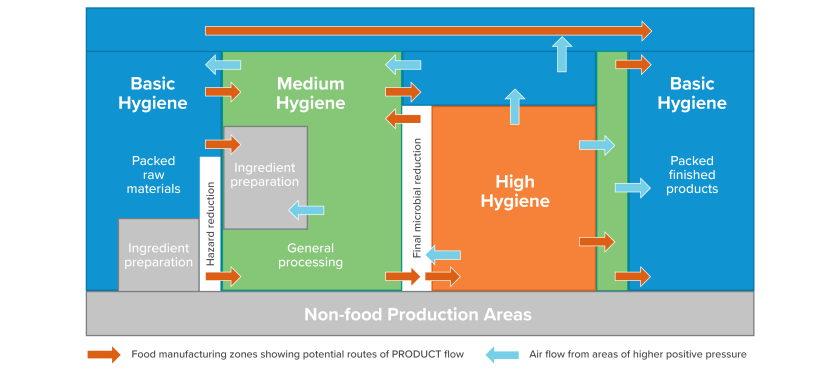
Air touches everything in the plant—workers, materials, equipment—and needs to be thought of as an ingredient. Airborne contamination with allergens, microbes, or foreign particles needs to be minimized. Rooms must be designed taking into account airflow, pressurization of certain spaces and filtration. Proper pressurization prevents the flow of contaminated air into clean spaces, such as from the loading docks to open product areas. Filtration helps reduce the amount of airborne contaminants.

Compartmentalize into hygienic zones
Each area of a food production plant is separated from others based on its function. Zones are typically categorized as basic-, medium-, or high-hygiene depending on the risk of and importance of preventing contamination. In the simplest form, materials tend to flow from a basic-hygiene zone toward a high-hygiene zone. At the same time, air and personnel should only flow from high-hygiene zones to medium- or basic-hygiene zones.

Decide on the correct room temperature
The temperature of production and storage rooms affects the design. There needs to be a balance between keeping food safe and maintaining the comfort of employees. For some products, the room temperature is dictated by regulations. For example, USDA guidelines require meat-processing rooms to have a temperature below 50°F. Rooms with processes that require steam or a water bed might have a temperature of 80°F and have humidity control to remove the steam to keep workers comfortable.

Prevent allergen contamination
Good layout and design help prevent allergen contamination. Designing for allergens includes assessing the flow of materials and personnel, air handling, segregation and cleaning. Dusty allergens, like milk powder, soy powder and aerosolized nuts, can require dedicated facilities and material handling systems.
Learn more about how facility layout and design help control allergens and avoid cross-contamination in your food facility.

Minimize access to uncovered or open food
Food products should be in closed containers whenever possible and only be accessible in a clean environment. When designing your facility and processing lines, consider how ingredients and product will move through the plant. Avoid piping or ledges that may cross over above open product, and consider covering lines to prevent contaminants or debris from coming in contact with food products.

Establish a dedicated plant clothing and captive shoe program
A dedicated plant clothing and captive shoe program is part of the cultural shift discussed above that will produce a food safety mindset, and it’s been adopted by 52% of alternative proteins manufacturers and 41% of pet food manufacturers, according to our Horizons: Alternative Proteins and Horizons: Pet Food reports. Personnel hygiene programs not only encourage cleanliness, but plant clothing can also be used to identify workers by the area they work in and, as such, contribute to your food defense plan.

Implement smart scheduling
Smart scheduling helps control cross-contamination of allergen-containing products or those with intense flavors or colors that are difficult to clean:
- When running several products back to back, the product with the lightest color is run first, for example, vanilla ice cream, and then the other flavors
- In a facility making a product with peanuts, all other production should be scheduled around that product. This could mean that peanut-free products are made Monday to Thursday, peanut-containing products are made Friday and the facility is completely cleaned Saturday.
Equipment design for food safety
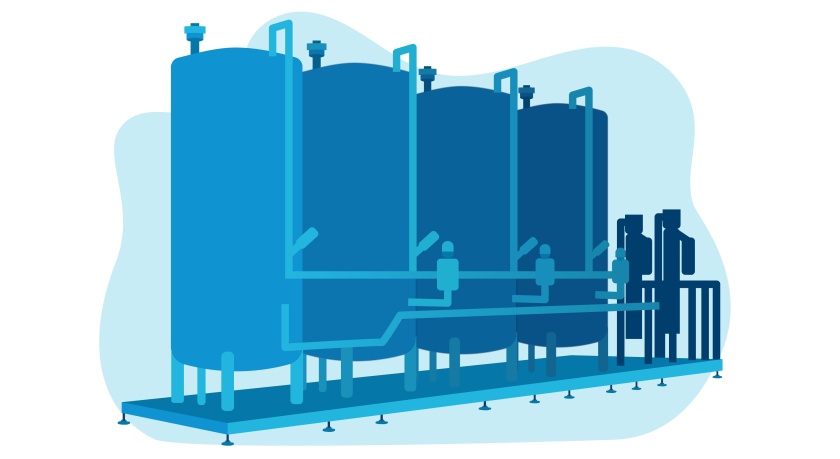
Food processing equipment must be designed to prevent contamination, allow thorough cleaning, clean in place (CIP) and/or sterilize in place (SIP) and be easy to maintain and repair. It is critical to work with an equipment vendor that understands these principles. Certifications such as 3-A Sanitary Standards and European Hygienic Engineering & Design Group (EHEDG) indicate that the equipment has been designed for ease of cleanliness.
Food processing equipment design
The design of food processing equipment plays a critical role in ensuring food safety by prioritizing cleaning, sterilization, and preventing any form of contamination. Manufacturers design equipment so that:
- It is drainable, including vessels, tubing and pumps.
- Cleaning can occur without disassembly or be cleaned in place.
- It is easy to maintain and repair.
- It can be sterilized in place.
- For aseptic processing, equipment is sterile throughout the process.
- Equipment does not fracture or flake during normal operations.
Dryers need to be designed for food safety because of the humidity they generate, both internal to the equipment and in the room itself. This humidity is a risk that encourages microbial growth.
Validation of hygienic equipment design
Validation ensures that the equipment can be used and cleaned in a way that all soil is easily removed, and that no standing water or residues remain before starting a new production cycle. Equipment manufacturers perform validation; however, they need information on the use conditions for the vessel. Consider working with a consulting firm like CRB that can guide you through the process and assist with writing guidelines.
Cleaning validation is performed after the equipment has been installed, and a test cycle has been run, to confirm if the cleaning regimen is sufficient. It is recommended to validate again after 6-12 months, after some wear and tear, to ensure that the equipment maintains the same condition.
Implementing a comprehensive food safety system
A lot goes into creating a food safety system, nurturing the company culture to execute it successfully and designing and building a facility that produces safe food products. A strong food safety system will build trust and credibility with consumers and stakeholders, safeguard brand reputation and minimize the risk of recalls.
Learn more about how CRB can assist with implementing a food safety system in your facility and operations to create a culture of safety, reduce risks and demonstrate your commitment to delivering safe and high-quality food products to consumers.

- Allergen: Allergens are components of different foods that can cause an allergic reaction in some consumers. Allergens are usually proteins specific to certain foods that trigger an immune response. The amount needed to cause an allergic reaction varies from product to product.
- Aseptic processing: Aseptic processing is a way to produce shelf-stable foods by separately sterilizing a food product and its package, then filling the product into the package within a sterile environment. The process produces a safe, ready-to-eat, shelf-stable product.
- Audit: Tool used to verify proper food safety practices in processing facilities. Audits are a critical component in maintaining food safety standards.
- Critical control point (CCP): A step at which control can be applied and is essential to prevent or eliminate a food safety hazard or reduce it to an acceptable level.
- Cross-contamination: The transfer of harmful material (e.g., microbes, allergens, chemicals, or other ingredients) from one person, object, or place to another. This can happen by hands, air, food-contact surfaces and utensils.
- Global Food Safety Initiative (GFSI): An international standard containing requirements for food processors to follow to build an effective food safety management system. Several other certifications derive from this standards such as BRC, SQF, etc.
- Food Safety Modernization Act (FSMA): Enacted in 2011, FSMA gives the US Food and Drug Administration authority to regulate the way foods are grown, harvested and processed. FSMA shifts the focus from responding to foodborne illnesses to preventing them.
- Food safety plan (FSP): A food safety plan includes the primary documents in a preventative controls food safety system, providing a systematic approach to identify food safety hazards that must be controlled to prevent or minimize the likelihood of foodborne illness or injury. The FSP is developed by the company and must be signed by the plant manager or company owner.
- Good hygienic practices (GHP): Good hygienic practices apply across the food processing chain. GHP includes food handling, employee hygiene, sanitation of facilities, pest control and prevention of physical and chemical hazards. GHP compliance encompasses the minimum sanitary and hygiene practices for food processors to ensure food is safe and suitable for human consumption. It is a required foundation to implement other food safety management initiatives, such as GMP, HACCP and ISO 22000.
- Good manufacturing practices (GMP): GMP addresses standard practices that help produce safe products. GMP addresses all steps of food production, including design, construction and maintenance of a food plant. It includes the plant grounds, plant equipment, sanitary operations, facility sanitation, personal hygienic practices and production and process controls during the production of food. Many countries have coded GMP into regulations.
- Hazard Analysis Critical Control Point (HACCP): A systematic approach to the identification, evaluation and control of food safety hazards. The method was originally developed by NASA with the Pillsbury Company to ensure the absolute safety of prepackaged foods for spaceflight. This systematic approach to quality control is now known as HACCP and has become an industry standard. HACCP principles and application guidelines can be found here.
- Hazard analysis and risk-based preventive controls (HARPC): HARPC was developed as a result of FSMA and, unlike HACCP, focuses on preventive controls. HARPC requires food manufacturers, processors, packers and storage facilities to identify potential food safety issues, adopt controls to address them, ensure the controls work and correct any problems that arise with the controls. While HACCP functions as a goalkeeper—the last line of defense against food safety issues—HARCP presents a series of hurdles that must be jumped over to get to the finish line.
- Process Authority: A process authority has expert knowledge of thermal processing requirements for low-acid foods packaged in hermetically sealed containers or has expert knowledge in the acidification and processing of acidified foods. Knowledge can be obtained by education, experience, or both.
- Recall: A food recall is an action by a food manufacturer or distributor of products that may cause health problems or possible death. The FDA organizes recall classification into three classes, according to severity. A Recall Plan is a necessary step for food safety.
- Risk analysis: The process of collecting and evaluating information on risks associated with every step of the production, storage and transportation of foods to decide which are significant and must be addressed in the food safety plan.
- Safe quality food (SQF) certification: HACCP-based food safety and quality management certification system recognized by manufacturers, service providers and retailers.
- Segregation: Act of protecting product through hygienic design to control product flow, personnel flow, welfare areas and environment. Segregation can entail modifying equipment to isolate the process, isolating the equipment itself, or isolating an entire room. Segregation may require several steps, including physical walls, airlock rooms and indirect walkways. All efforts must take into account air handling and the way air flows so the higher pressure maintained in segregated areas causes clean air to flow out and prevents dirty air and particles from entering.
- Thermal processing: The use of temperature to reduce populations of microorganisms or to alter the flavor of foods. Thermal processing preserves foods.
- Traceability: The ability to rapidly and easily follow the movement of ingredients in a food product, products in-process and final food products throughout the supply chain.
- Validation: An important step in food safety, in which a process is validated by establishing and documenting scientific evidence that food safety hazards are being controlled and that products will be safe during the expected shelf life.
Given the need for a safe food supply, the range of regulatory bodies is wide.
As found when surveying industry experts for Horizons: Pet Food in 2022, pet food production facilities are largely operating on the same standards and hygiene practices as human food. Meanwhile, regulations for the production of alternative proteins continue to evolve. Companies are also acquiring safety and quality certifications to validate the hard work they are doing to ensure a safe food supply. All this is good news for consumers.
Here’s a list of the regulatory agencies and certifying bodies relevant to food production.
Food and Drug Administration (FDA)
All foods must comply with the FDA’s Federal Food, Drug and Cosmetic Act, as well as the Food Safety Modernization Act (FSMA), and all facilities must comply with good manufacturing practices (GMP). The FDA regulates pet food and seafood, but not livestock, and there are unique regulations for juices, milk and dairy, low-acid foods, acidified foods and seafood.
In terms of alternative proteins, the FDA regulates the collection, growth and differentiation of cultured cells. Once the cultured cells are harvested, jurisdiction moves to the USDA, which regulates processing, packaging and labeling.
The Center for Food Safety and Applied Nutrition (CFSAN) carries out the food safety work of the FDA, supporting consumers, industry.
Food Safety Modernization Act (FSMA)
FSMA focuses on prevention of foodborne illness and is mandated to issue food recalls. The FDA maintains a list of guidance documents and regulatory information for food and dietary supplements.
What’s coming down the pipeline?
A recently approved regulation added sesame to the FDA list of 9 major food allergens. Others include milk, eggs, fish, crustacean shellfish, tree nuts, peanuts, wheat and soybeans. Other updates include:
- Changes to labeling regulations
- A verification program for suppliers of imported food to fast-track imports from regular suppliers
- Alterations to the food defense plan
US Department of Agriculture (USDA)
The Food Safety and Inspection Service (FSIS) of the USDA regulates the safe production, packaging and labeling of food from all livestock, including beef, pork, sheep, goats, poultry and eggs. It also regulates all aspects of cultivated meat production following harvest of cultured cells.
The Centers for Disease Control and Prevention (CDC)
The CDC monitors foodborne illnesses and food safety in partnership with the FDA and the USDA.
Environmental Protection Agency (EPA)
The EPA ensures that all pesticides applied to food are safe, under the Food Quality Protection Act (PQPA).
European Food Safety Authority (EFSA)
While not a regulatory agency, the EFSA provides advice on food safety risks to the European Union.
Canadian Food Inspection Agency (CFIA)
The CFIA provides food safety guidelines and regulatory requirements for industry.