Optimized biostorage design cuts energy by 60%, saving $500k annually
Rethinking freezer design in biotech can cut operational costs by optimizing energy, heat and real estate. Here’s how.
Biostorage freezers are a prominent fixture in biopharma operations for the storage of biosamples, plasma, cell banks, gene therapy vectors and other sensitive materials for clinical and commercial manufacturing. These cold storage facilities often contain dense rows of individual freezers, resembling data centers in their layout and operational demands, consuming significant amounts of energy while generating substantial heat waste.
This is often just looked at as a necessary burden to operations and OpEx, without question. But what if you could keep the freezer but ditch the heavy resource load and lower OpEx?
This is exactly what CRB’s sustainability engineers asked on a biotech project, finding huge savings by:
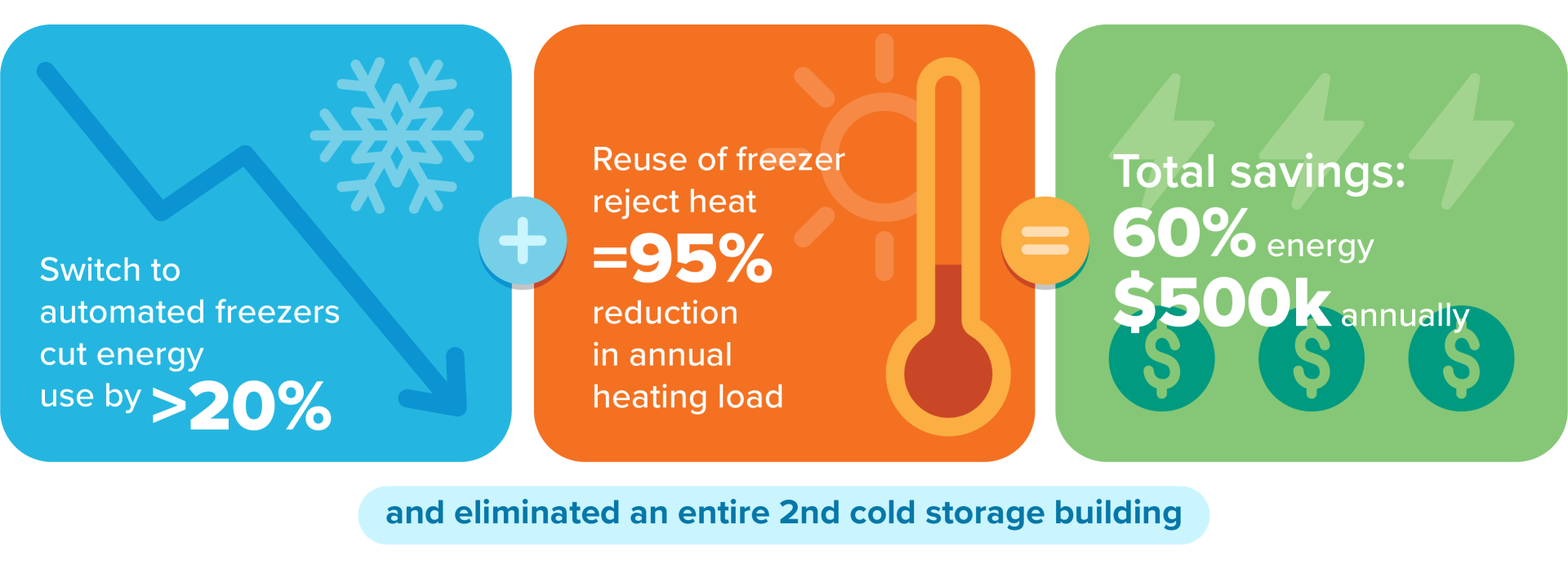
- Meeting 95% of the building’s annual heat demands from heat reuse
- Reducing freezer energy consumption by more than 20%
- Reducing facility-wide energy consumption by 60%
Rethinking this standard design is estimated to save the manufacturer $500k annually.
Why is energy efficiency needed?
Sometimes referred to as “freezer farms,” biostorage freezer centers often operate at very specific cold or ultra-cold temperatures (-20°C to -150°C) to ensure the safety of the sensitive materials they contain. A biotech freezer farm could contain dozens or even hundreds of freezers. Maintaining one of these spaces is extremely space and energy-intensive. To put the need for a more efficient biostorage room design into perspective, let’s start with the challenges actively working against these spaces:
- Running freezers 24/7
- Regular opening of freezer doors to set and retrieve materials
- Less than optimal sample arrangement
- Standard vent placement
- External ambient and peak season temperatures
- Use of traditional refrigerants
Engineering an alternative solution
Understanding not only the energy the biostorage center consumed but also the heat refrigeration rejects allowed our team to think in the big picture when exploring alternative solutions for this project. Ultimately, implementing an innovative, data-backed approach with a widely applicable solution for biobank operations with impressive CO₂ reductions.
While designing a fully electrified, integrated, energy-optimized biotech facility, additional scrutiny was placed on the biobank freezer system to help reduce the known resources and environmental drawbacks, such as the significant energy draw and traditional refrigerants mentioned above.
The question was if the project should use automated vs. standard freezers. The automated freezers initially appeared to have a higher energy use compared to manual reach-in freezers when calculated using the traditional watts per square feet method. However, when evaluated on a per-sample basis, the automated freezers were far more energy-efficient. This option would allow the client to triple the capacity of sample storage within the same footprint, eliminating the need for an additional cold storage building while still housing the same number of samples.
A strategic biofreezer facility design
As a result, the project was configured for the automated ultra-low temperature (ULT) freezers with CO₂-based refrigerants, a natural alternative to traditional refrigerants. Further, the team designed the building mechanical system to make strategic use of the heat reject. The automated freezers reject heat goes directly to a chilled water loop, which is utilized by the air-water heat pumps (AWHPs) providing space heating.
In combination, the recovered heat on the project supports approximately 95% of the annual heating load for the building. When compared to an ASHRAE 90.1 -2010 baseline, the project as a whole demonstrates a 60% savings against that baseline.
The freezers themselves represented a more than 20% energy reduction. In combination with heat recovery the project is estimated to save approximately $500k annually. This solution also eliminates the need for an entire second energy-intensive biostorage building to support the future projected sample load.
This was a scalable, data-backed solution that improves sample integrity, reduces operational complexity, and advances the client’s decarbonization goals—proving that sustainability and high-performance operations go hand in hand.
Additional tools for reducing energy needs
There are additional tools used throughout biopharma to optimize energy in these complex, resource-intensive spaces, enabling even greater savings.
Energy modeling and building analytics provide simulation opportunities to evaluate the flow of resources (energy) through a building. By creating a holistic model, building design options can be evaluated and systems optimized to support building efficiency and reduce risk.
It’s time to reduce your energy loads
CRB’s sustainability, energy modeling and building analytics experts have the tools to help you reduce excessive energy consumption within your operations. Reducing energy use is not just a win for environmental goals; it’s a win for maintenance teams, operations and annual budgets.
Talk to our team today.