

AMR planning and design needs for better mobile robots, equipment, and workflow interactions for biotech
Read More
The full value of lab automation: Technology, trends and strategy
“Lab automation” is a vast concept. It encompasses everything from a single instrument performing a repetitive task to AI-enabled ecosystems autonomously processing and analyzing samples. Between these two extremes lies a spectrum of applications, such as robotic arms transferring material between instruments, automated liquid handlers preparing assays, and mobile robots moving samples through the lab.
Where does your lab’s current automation fall on that spectrum? As technologies mature and bespoke systems enter the mainstream, where could your automation strategy go? How will you take it there?
Every lab team will answer these questions differently, but most are united by one fact: automation is here, and it’s changing the laboratory environment. We see evidence of that in our 2026 Horizons: Life Sciences survey of more than 400 large and small manufacturers from around the world.
69% of manufacturers currently use or plan to use robotics in R&D workflows, according to our 2026 Horizons: Life Sciences survey.
There are strong benefits driving this trend. A right-sized automation strategy can support greater speed, flexibility, cost efficiency, and quality in the lab. At the same time, pursuing lab automation can introduce new challenges.
To address those challenges, lab planning teams need to evaluate their strategy from several angles:
- Where will your lab automation strategy deliver measurable ROI?
- What lab space and infrastructure will your automation require?
- How will lab automation affect the workforce?
- What does a realistic automation startup timeline and post-launch maintenance regimen look like?
Teams retrofitting an existing lab face an added layer of questions:
- How does the existing footprint support (or limit) our target level of automation?
- How will new systems integrate with legacy equipment and infrastructure?
This article examines these lab automation planning realities, drawing lessons from both retrofits and greenfield projects as well as from exploratory R&D environments and fixed-protocol QC labs.
The goal is to understand how today’s project teams approach automation, and how the combined expertise of lab planners and automation specialists can unlock the long-term value of a lab automation investment.
Who is adopting lab automation and why?
Different roles, different implementation pressures
Not every lab arrives at automation from the same starting point, or with the same set of goals. Depending on your lab type or the nature of your automation project, the pressures and risks you face will change, and so will the decisions you make to move your project forward.
R&D versus QC labs: Two automation mindsets
Speed to market is a priority in the R&D lab. Under this pressure, research teams are exploring technologies that promise faster outcomes. Artificial intelligence is a major part of this story. Analysts expect the global market for AI in the pharma industry to grow at a compound annual growth rate (CAGR) of over 40% by 2031. Efforts to compress drug discovery timelines are one of the strongest drivers behind this meteoric growth.
An appetite for tech-enabled research isn’t limited to AI use cases. Lab teams are turning to automation as part of the same broader push to accelerate R&D outcomes. There may be an element of the “R&D mindset” at play here, too: the exploratory and iterative nature of pharmaceutical development creates a fertile ground for implementing, testing, and tailoring new automated systems.

PRO TIP:
When designing an automation strategy for an R&D lab, prioritize adaptable systems that can accommodate shifts in methodology and workflows, even if that means sacrificing short-term throughput or including additional space.
In QC labs, product safety is paramount, supported by accuracy and compliance. But meeting quality requirements in a manually driven lab environment is difficult, particularly for QC teams facing high-throughput workflows.
Personalized medicine is a good example: without some automation, managing the volume of samples required to support a “one batch, one patient” reality would be unsustainable. But unlike R&D labs, the highly regulated, protocol-driven environment of QC is less conducive to experimentation with automated systems, even when a Manufacturing Science and Technology (MSAT) team has done much of the technical groundwork. Lab owners need the backstop of proven use cases and a clear business case before moving forward with an automation investment.
PRO TIP:
QC teams need consistent results that align with regulatory expectations. Their automation strategy should reflect these priorities by enabling stable, repetitive, high-volume workflows with reliable traceability.
Greenfield versus renovation projects: Two implementation realities
When setting out to design a lab automation strategy, greenfield and renovation teams begin from very different positions.
On a greenfield project, lab planning teams have the opportunity to design for automation from day one. Footprint, utilities, data infrastructure, material flows, and maintenance access—each of these variables is malleable to a certain extent, giving project teams the freedom to shape physical realities around their automation strategy.
PRO TIP:
Greenfield teams should start by defining their automation strategy. This is an opportunity to challenge existing operational paradigms and think through both initial implementation considerations and long-term automation goals. Once in place, this strategy can help shape early building design decisions, including facility sizing, blocking, and stacking.
Planning teams working on a lab renovation face different challenges. Instead of designing the environment to support automated systems, they have to work the other way around, fitting automation into a fixed space with established infrastructure and pre-existing workflows. They also face additional startup pressures, especially when it comes to minimizing impacts on day-to-day operations while installing, tuning, and validating new automation systems.
PRO TIP:
On renovation projects, start by identifying areas with the least flexibility, such as footprint, utilities, or shutdown timelines, then design an automation approach that can deliver ROI within those constraints.
In our 2026 Horizons: Life Sciences survey, 49% of respondents say they’re prioritizing automation when it comes to modernizing legacy facilities, including labs.
High-value use cases in today’s labs
The goal isn’t simply to replace manual steps, but to reshape lab workflows in order to improve throughput, consistency, and safety. Most of all, smart automation implementations free scientists to enjoy the high-value, human-driven work that first attracted them to this career.
Sample transport and movement
The simple task of moving samples through a lab offers a compelling automation opportunity.
Labs that rely on personnel to move samples between points are limited by headcount and availability, which can lead to delays. In cases where turnaround time is vital, such as facilities manufacturing personalized medicine, these delays might become disastrous from both a business perspective and in terms of patient outcomes.
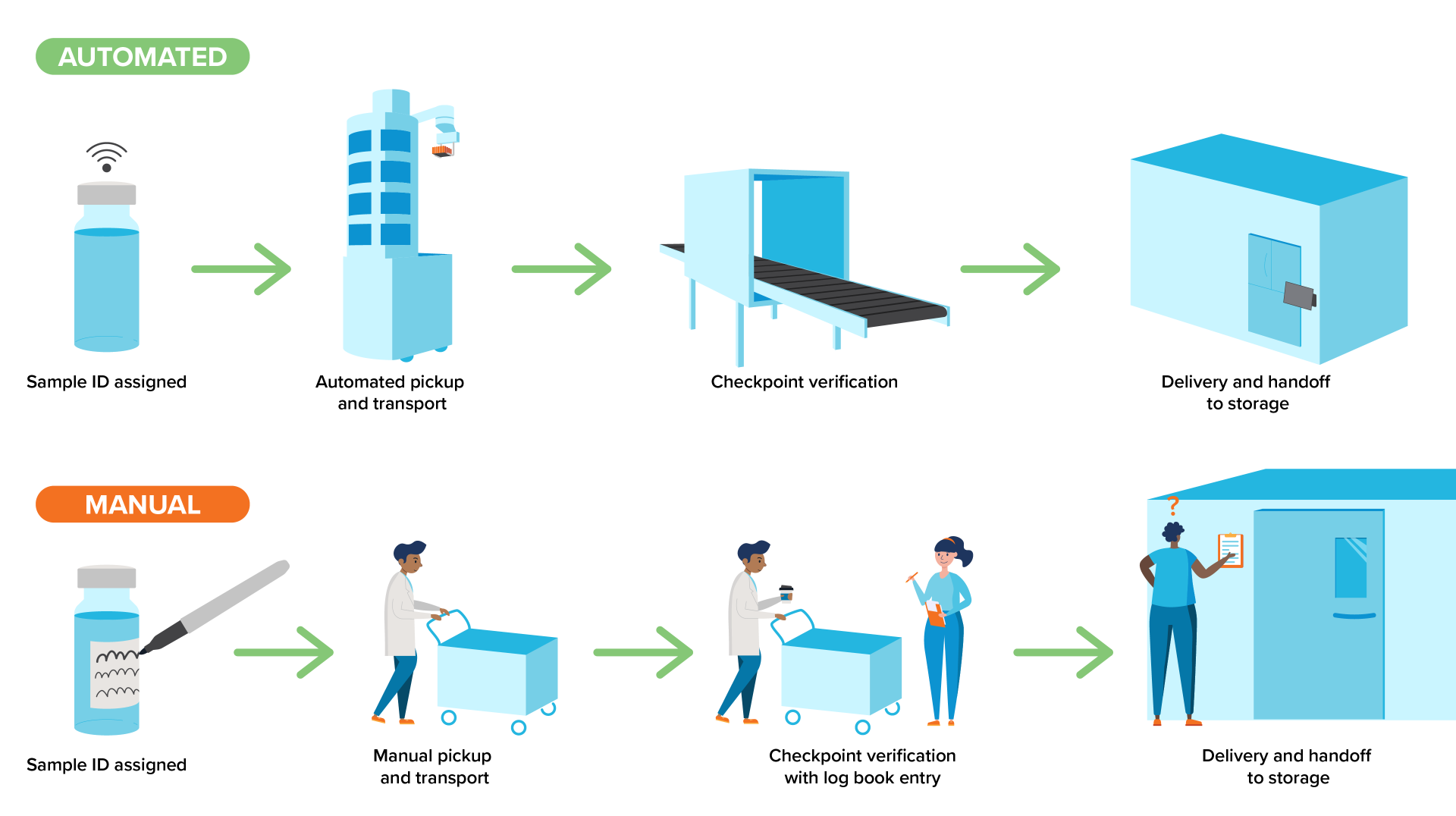
Even when personnel are available to move samples quickly, other challenges arise. For example, human-driven workflows rely heavily on perfection. Scientists must manage every handoff, label check, scan, and documentation perfectly; otherwise, labs risk compromising traceability and chain of custody. But expecting end-to-end perfection from a fully manual operation is often unrealistic.
Labs can close these gaps by shifting responsibility for sample scanning and movement from humans to automated systems, thereby reducing or eliminating unforeseen delays or manual data entry errors. These automated systems also contribute to a more connected data ecosystem across the wider facility, helping lab teams assess overall operations with greater clarity and confidence.
Sample transport and movement in an automated lab
- Sample generated or collected at the bench or in a manufacturing area
- Sample ID assigned
- The automated system assigns a unique sample ID. A tracking technology such as radio-frequency identification (RFID) scanning captures that ID.
- Automated pickup and transport through the facility
- At the origin point, a robotic arm picks up and transfers the sample, either from a stationary position or as an integrated component of an Autonomous Mobile Robot (AMR). The sample then moves through the facility using mobile transport systems such as AMRs or fixed-path systems such as a conveyor, pneumatic tube, or magnetic track.
- Checkpoint verification
- At each transfer point, automated scans confirm the sample’s identity, location, and custody.
- Delivery and handoff to QC lab, storage unit, prep station, etc.
- The connected data system records delivery, routes the sample (or samples) to the appropriate work cells, and documents test results in the LIMS and the Electronic Batch Record.
Sample handling and preparation
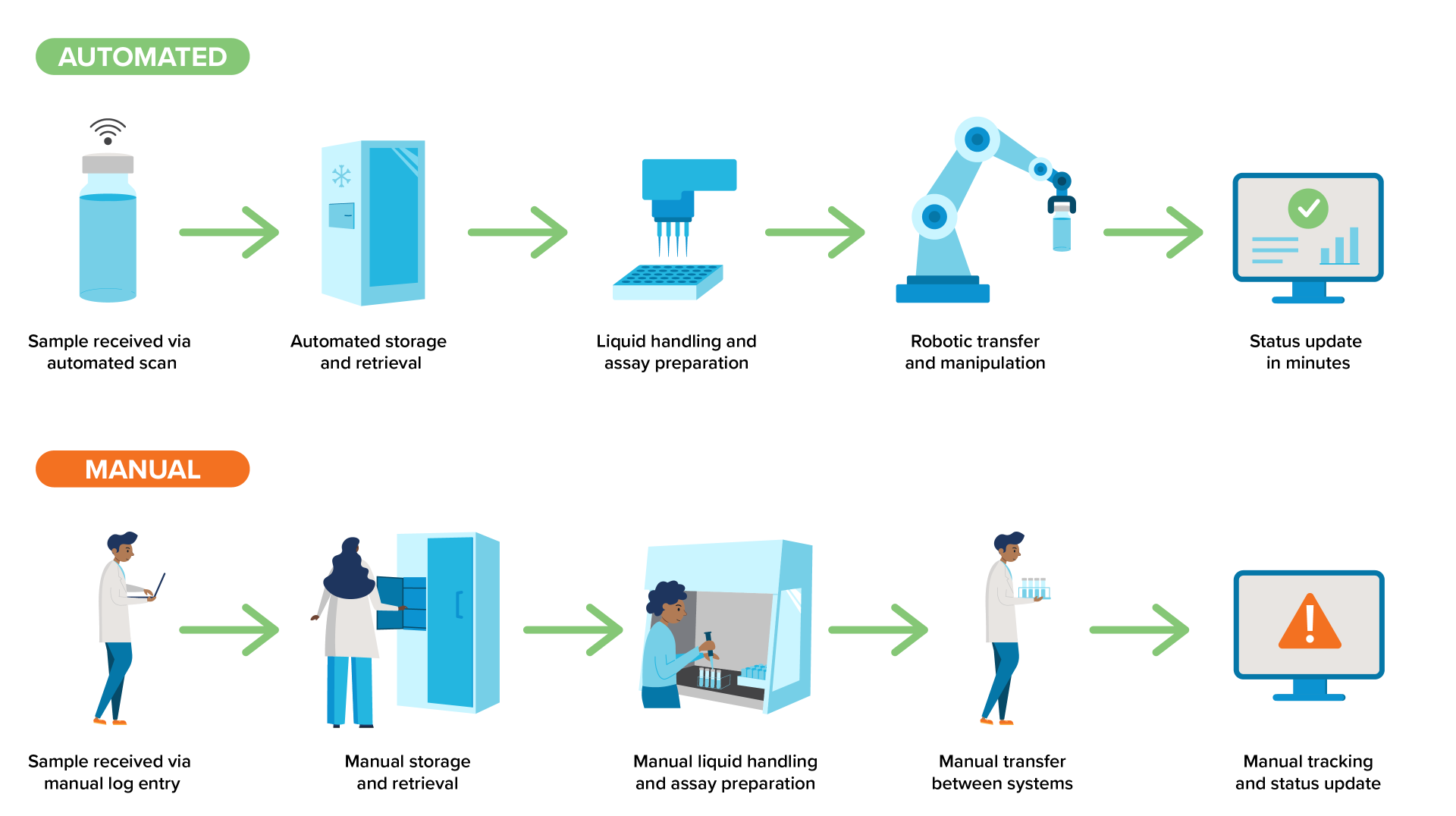
Automation can also play a meaningful role in lab workflows themselves by taking on repetitive tasks that otherwise tie up the human workforce. As with sample movement, shifting these tasks to a robotic system can greatly improve speed and reliability, freeing scientists to focus on their area of expertise.
Speed is only one potential benefit of automated sample handling. A well-designed system is also a lever for lowering lab OpEx. For example, after implementing an automated biobank freezer system alongside a heat recovery strategy, a recent client lowered their projected freezer energy consumption by 20% and cut their annual OpEx spending by $500,000. This shift to automation also reduced their capital spending requirements; by moving away from space-intensive reach-in freezers, they eliminated the need to build an entire second cold storage building.
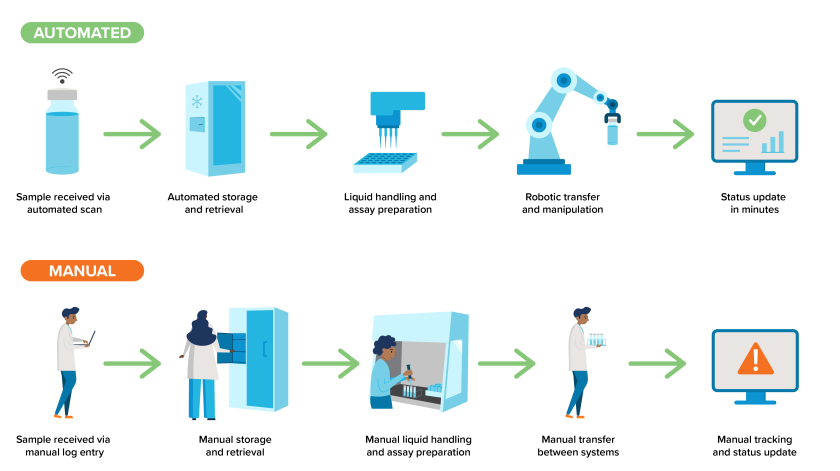
Sample handling and preparation in an automated lab
- Sample received at the prep station
- The automated system confirms the sample’s identity and retrieves workflow instructions.
- Automated storage and retrieval
- Robotic systems store or retrieve the sample from controlled-temperature units, if required.
- Liquid handling and assay preparation
- An automated liquid handler performs tasks such as pipetting, dispensing, and plate preparation.
- Robotic transfer and manipulation
- A robotic arm or cobot moves the sample between preparation systems, storage units, and analytical instruments designed to integrate with the automated system.
- Handoff
- The automated system delivers the prepared sample to the next workflow step.
- Status update
- The connected data system records each step, instrument handoff, and completed task.
Case study: People-focused innovation in a lab retrofit project
The challenge
Scientists in this high-throughput QC lab were under pressure to accelerate turnaround time without losing the quality-driven, human-led scientific judgment they relied on.
The approach
Our team was tasked with developing a “QC lab of the future” strategy that would keep scientists at the center of the testing process while reducing their burden of repetitive tasks. To meet this goal, our lab planning and automation consultants applied tools such as value stream mapping, spaghetti mapping, and simulations to analyze the lab’s current workflow and model hypothetical scenarios enabled by varying levels of automation. In this way, our integrated project team identified where automation would deliver the greatest value.
The solution
We analyzed commercial off-the-shelf robotics systems to support routine tasks such as pipetting and sample preparation, with handoffs to the scientific team at points where their expertise mattered most.
The outcome
This lab automation project resulted in:
- Reduced QC turnaround times
- Reduced annual outsourcing costs
- Enhanced compliance
- Better visibility, collaboration and lab ergonomics
Environmental monitoring
Automated systems can play a vital role in labs that require ongoing environmental monitoring (EM). Unlike a traditional EM workflow, in which an operator reviews individual samples, manually inspecting each one and documenting results, an automated system can process large volumes of samples quickly, consistently, and without breaks.
In most scenarios, the robotic system doesn’t replace human judgment altogether; instead, it operates on an escalation model designed to flag out-of-specification results for review. This ensures that trained scientists can invest their time where their expert judgment is most needed.
Technology spotlight: Automated environmental monitoring in action
Automated microbial detection is becoming a mainstream capability in modern QC labs. These systems build on familiar compendial sample preparation methods, adding specialized media cassettes, barcode tracking, automated handling, and dual incubation. Through frequent optical scanning with autofluorescence imaging, these systems can detect microbial growth earlier, reducing the burden of manual review. Because this testing process is non-destructive, microbiologists can still retrieve samples for identification when required.
Lab robotic systems are becoming more bespoke
For many labs, off-the-shelf robotic systems designed for broad application are the gateway to automation. But as lab automation technologies mature, modular systems that are customized to integrate with lab-specific automation strategies are entering the spotlight.
In 2024, our Horizons: Life Sciences survey showed that 47% of manufacturers planned to adopt custom robotics by 2029. Today, the industry appears on track to meet that goal, particularly in the lab environment. Our lab planners and automation specialists, working with owners across the industry, are seeing a shift from early adoption of their first bespoke systems to cycles of iteration, optimization, and improvement. Some labs that adopted tailored robotics systems within the last five years are now implementing 2.0 versions.
Bespoke automation systems offer important efficiency and throughput benefits for highly specific biopharma lab workflows. QC labs can design systems to support major increases in throughput without adding significantly to headcount. In R&D labs, a bespoke system gives scientists the flexibility to quickly reconfigure workflows and run them outside of regular work hours.
These benefits come with some tradeoffs. The more customized the automation system, the greater the implementation challenge for lab teams, often leading to a larger capital commitment and a longer path to startup. Design and validation alone are complex undertakings; then, once implemented, a bespoke system also requires dedicated expertise for tuning, troubleshooting, and maintenance. And without a standardized vendor playbook, lab teams may also need to devote more time and resources to workforce training.
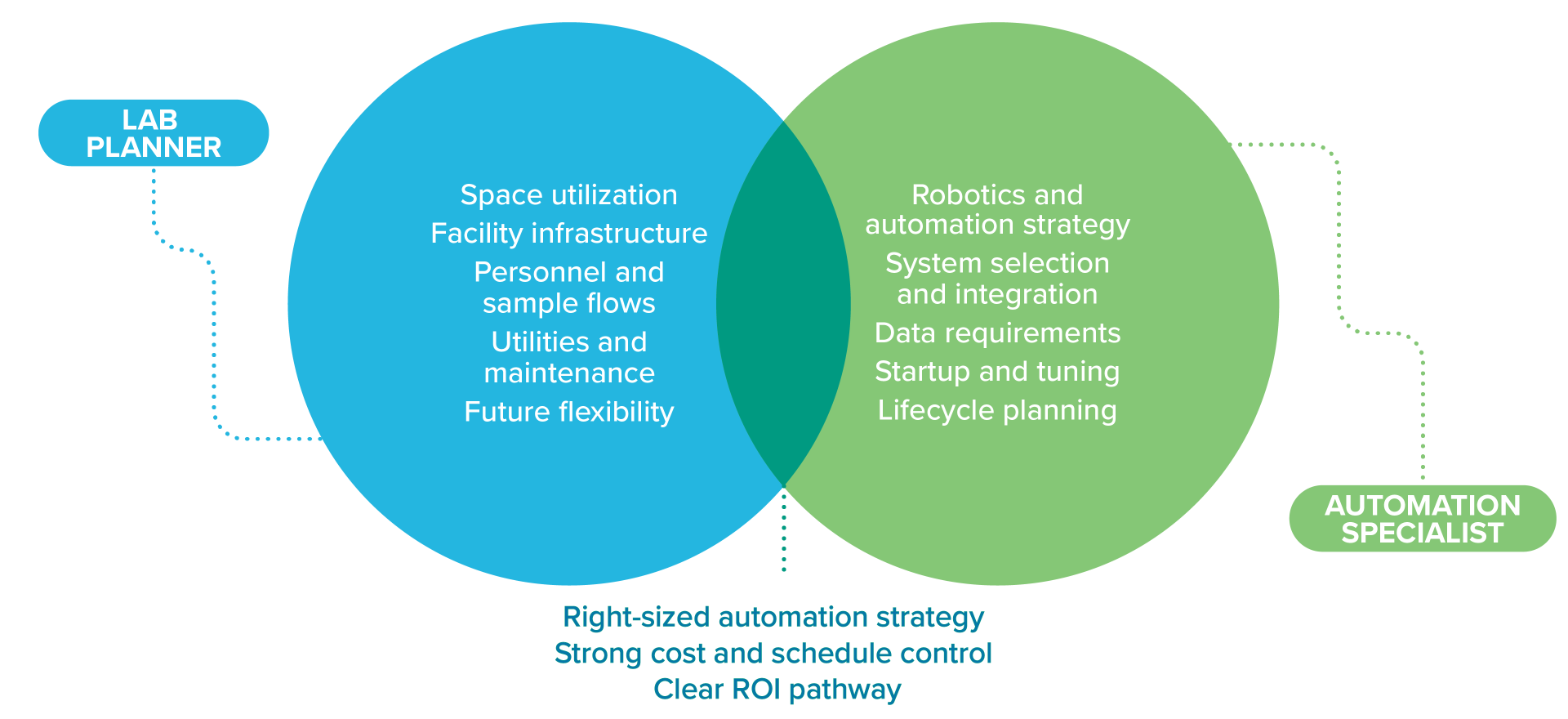
A coordinated implementation strategy is a lab’s best defense against these challenges. By bringing lab planners and automation specialists together, project teams can develop tailored approaches that reflect the lab’s specific operational needs while taking into account factors such as available capital, timeline constraints, available space, and long-term automation goals.
The implementation reality: Where lab planning and automation meet
When lab automation first entered the mainstream, the question our project teams heard most often from lab leaders was some variation of: “Which technology should we implement?”
Today, that question has evolved. The challenge is no longer only about selecting the right system; it’s about understanding how that system will perform inside a real operating environment with constrained space, complex workflows, established infrastructure, connected data systems, and a network of human operators, each with different skills, responsibilities, and needs.
The way an implementation team navigates these complexities directly impacts the ROI of any new automated system, bespoke or off-the-shelf. Even a system that performs exactly as designed will lose value if it can’t integrate smoothly into the lab around it or if it requires manual handoffs that weren’t accounted for.
To avoid these roadblocks and unlock a system’s full value, project teams should involve lab planners and automation specialists from the beginning of system definition. Phase-by-phase, this cross-functional team knows the right questions to ask before locking in key design decisions, ensuring “day one” alignment between what the system needs from the lab and what the lab needs from the system.
Questions to ask for better lab automation planning and system alignment

Concept phase
What problem are we solving for, and is automation the right solution?
- At this stage, an integrated lab planning and automation strategy team will develop blocking diagrams to explore system sizing, spatial relationships, and the flow of people, materials, and samples through the lab. These early explorations help the team assess the impact of proposed automation projects on a specific lab environment, ensuring the benefits justify the implementation costs.

Basis of design (BOD) phase
What will this automation strategy require from the facility?
- In this phase, the integrated team evaluates the space, utility capacity, network infrastructure, and maintenance access involved in a successful implementation. Project teams must also identify the biological, chemical, and physical hazards associated with the planned implementation, along with containment, access controls, and other considerations needed to safely mitigate those hazards.
- In both greenfield projects and renovations, this coordinated effort helps lab planning teams right-size the automation solution and its supporting infrastructure. In renovation projects in particular, it also helps the integrated delivery team to proactively identify retrofit constraints.

Detailed design phase
How will the system work in day-to-day operation?
- For the integrated lab planning and automation specialist team, the goal at this phase is to pressure-test all interactions involving the planned automation system and translate those interactions into a fully coordinated facility design. How will the automated system interface with instruments, existing software platforms, the lab or facility’s broader data infrastructure, other automation systems, and people? At the same time, how do construction-level requirements, such as materials and utility connections, support reliable operation?
- Evaluating these interactions in detail will help ensure that the new automated system functions as intended within the lab’s real-world workflow, avoiding field delays during installation and reducing the need for operator intervention once the system is in place.
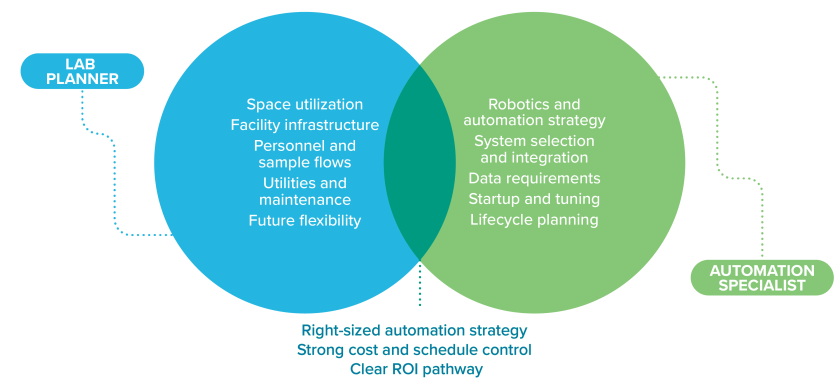
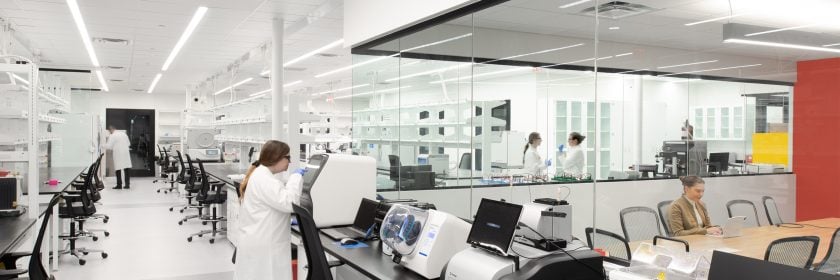
Designing the right environment for lab automation
To ensure that lab automation systems perform reliably, project teams need to design around the realities of the physical environment from the outset. That means carefully considering constraints and opportunities related to footprint, infrastructure, sample and personnel flow, maintenance access, and future flexibility.
Planning around footprint and throughput
Automated systems often require more physical space than the manual workflows they replace. That can seem like a drawback at first, but footprint is not the only measure of efficiency. While a robotic system may occupy more space in absolute terms, when designed well it may enable higher throughput per square foot.
Following that logic, the question about physical space isn’t how much, but rather how productive. By looking at footprint and throughput together, lab planners and automation specialists can evaluate where automation will truly densify operations enough to justify the added space requirements.
This calculation will look different on greenfield versus renovation projects. On a greenfield project, project teams have more freedom to design the lab around a robust automation strategy from day one. Planners and automation specialists may use this freedom to find new ways of allocating space; for example, while natural light is a priority in environments where people spend their working hours, it may not be required in highly automated workflows. This could open the door to internal “lights-out” spaces, reserving perimeter areas for people-driven working environments.
For renovations, project teams have to work around existing constraints. There’s only so much footprint available; there’s an existing utilities system; there are legacy workflows that may be difficult or impossible to adapt. Project teams must also account for the cost of a shutdown and the lost productivity it entails, as well as commissioning challenges and the complexity of startup when new and existing functions co-exist for the first time. Anticipating these constraints before implementation begins is key.
Managing flow through the lab
Automation changes how people, materials, and waste move through the lab. Good planning means understanding these changes from the outset and establishing a design that avoids conflicts, ensuring the lab operates with greater efficiency and safety following implementation.
This is another area where lab planning and automation strategy pay off. The automation team defines what the system needs to do and how it needs to move to achieve those objectives, while the lab planning team determines how those movements can happen safely and efficiently within the reality of the lab.
Case study: An overhead highway for moving samples in a greenfield lab
The challenge
This greenfield lab presented a clear opportunity for automation: its workforce would need to move a high volume of material between lab areas quickly, reliably, and with as little human intervention as possible. The lab team had two key criteria: eliminate conflicts between the robotic transport system and the flow of people in the lab, and preserve enough flexibility to accommodate future layout changes without major rework or disruption.
The solution
Our integrated lab planning and automation strategy team engineered a dedicated overhead track system featuring miniaturized autonomous vehicles. Internally referred to as “the highway at the ceiling,” this track is designed to interconnect and interact with zone-specific robotics systems.
Outcomes
By moving high-volume traffic overhead, this solution reduces conflict with ground-level flows of people and equipment. And because the overhead system interfaces with smaller local systems, each designed to navigate a limited area, future layout changes won’t require extensive reprogramming.
Designing an automated lab system
Connecting equipment, data and workflow
To deliver value in the lab, an automated system needs to integrate smoothly with the lab’s overall operating environment, including its instruments, software platforms, data infrastructure, materials and human-driven workflows.
Automated systems need to connect with the physical environment around them, but their connections don’t end there. They also need to support the flow of information that surrounds each sample. That means plugging into a system designed for rigorous tracking, chain of custody, data capture, test status, results and handoffs with operators.
In a QC lab, for example, moving samples quickly from one point to another is only part of the automated system’s remit. Its deeper value depends on the data trail it generates, giving lab teams real-time insight into where a sample is, what has happened to it, and what step comes next.
Planning for startup
As noted above, lab automation systems are trending away from prepackaged options and toward customization. As this trend continues and these bespoke systems grow in complexity, the gap between installation and reliable operation is lengthening. In this critical startup window, automation specialists need to tune, troubleshoot and intervene in early system performance; meanwhile, the lab team must train users on operating and maintaining the new system.
Experienced delivery teams account for this startup window in their operational readiness plan, eliminating surprises in the lead-up to “go live.” By defining a realistic timeline, this plan helps project teams set accurate expectations, allocate resources appropriately and avoid surprises during startup.
Designing around real-world inputs
Automation systems are designed around specific material form factors. To ensure reliable lab operations, the project team must define the containers, packaging and other inputs that the system will handle, then formalize those requirements in vendor specifications. Once the system is operational, every input needs to meet the approved specification.
This is another area where lab planning and automation strategy need to work together. An integrated, cross-functional team can evaluate the full material pathway before choosing or designing an automated system, identifying areas where form-factor requirements, layout decisions and supplier specifications converge to support real-world biopharma performance.
Designing automation for flexible, long-term performance
A successful lab automation strategy looks beyond startup to anticipated future needs: workflows that evolve, pipelines that expand and business priorities that grow and shift.
Balancing today’s needs and tomorrow’s growth
Robotic systems, off-the-shelf or bespoke, are often designed around a specific workflow or operational need. That focus is the key to greater efficiency, but what happens when the lab needs to change? These systems can be difficult and costly to adapt as new processes or technologies emerge, preventing labs from keeping pace with industry changes.
Limited flexibility is especially challenging for research labs. Unlike QC labs, which typically rely on stable workflows, R&D scientists are often navigating shifting methods, assays and priorities while facing growing pressure to reach the market quickly. In this environment, flexibility is a must. Trading some near-term throughput for an automated system that can handle ongoing adaptations without a costly redesign often makes sense.
Lab planning and automation expertise can help navigate these trade-offs. The goal isn’t to design for maximum flexibility at any cost; instead, it’s to define the right balance between current needs, future growth and long-term ROI, then translate that definition into a forward-facing lab design and automation strategy.
Planning for lifecycle and maintenance realities
Automated systems may run more intensively than the manual workflows they replace, sometimes moving closer to near-continuous operation. That changes the lifecycle assumptions around the equipment involved. Often, this is a complicated calculation. A single automation platform may involve multiple analytical instruments, robotic arms, handlers, conveyors, scanners, software and other integrated components, each tied to a discrete maintenance schedule.
To manage that complexity, project teams should develop a risk-based asset management plan that accounts for several vital questions: How will technicians access different components of an automated system for service? How much of the system will come to a halt if a certain component goes offline? Is there enough redundancy or spare capacity to help keep critical workflows moving? (The cell therapy industry provides strong examples of automation systems designed with zero tolerance for failure.)
By answering these questions proactively, lab teams can prevent minor maintenance issues from ballooning into major operational disasters, protecting both day-to-day uptime and long-term performance.
Preparing the workforce to support automation
An automated system’s long-term performance depends not only on the system itself, but on the people and processes that support it. Fortunately, many modern automation platforms feature user-centric software that makes them more accessible to non-engineers. A trained operator, for example, may be able to adjust a robotic arm or modify a workflow within defined constraints, even without programming expertise.
But accessibility doesn’t eliminate the need for specialized training. In fact, manufacturers are anticipating a significant investment in upskilling; in our 2026 Horizons: Life Sciences survey, 63% say that the time required to train their workforce is a “top three” concern when it comes to planning for automation.
Site selection also plays a role here. Companies planning large automation investments may need to consider access to talent when choosing the location of a greenfield facility; in the same Horizons: Life Sciences survey, nearly 80% of respondents say that access to skilled workers, including technicians, is a “top three” location driver.
Case study: Upskilling scientists to optimize automation
While supporting a lab on a new automation project, our team spoke with a scientist who had learned to make small, controlled adjustments to a robotic arm herself, allowing her to fine-tune the system around her day-to-day workflow needs. This meant she didn’t have to wait for a specialist to make every minor change.
This example illustrates an important shift in workforce training. When lab personnel develop the skills to supervise, configure and optimize automated systems within defined limits, they can resolve small issues before those issues disrupt larger workflows. The result: labs run more smoothly and scientists spend more time actually doing science.
Lab automation in biopharma today
In today’s R&D and QC labs, automated systems are helping lab teams move faster, increase flexibility, control costs and improve quality. But it’s not just the technology inside an automated system that creates value; it’s the lab around it, and how every instrument, workflow, data system and human operator integrates with that automated system to ensure ongoing performance.
Unlocking that value requires integration, and integration begins well before installation. It involves not just lab planners but automation specialists with the expertise to develop real-world system requirements. By establishing this cross-functional team before finalizing key decisions, lab owners can confidently identify the right automation opportunities, plan for strong cost and schedule control, and move smoothly from initial capital investment to ongoing, real-world value.
Our lab planners and automation specialists can help you design a strategy that fits your facility, from day-one implementation to long-term performance. Talk to our lab automation team today.
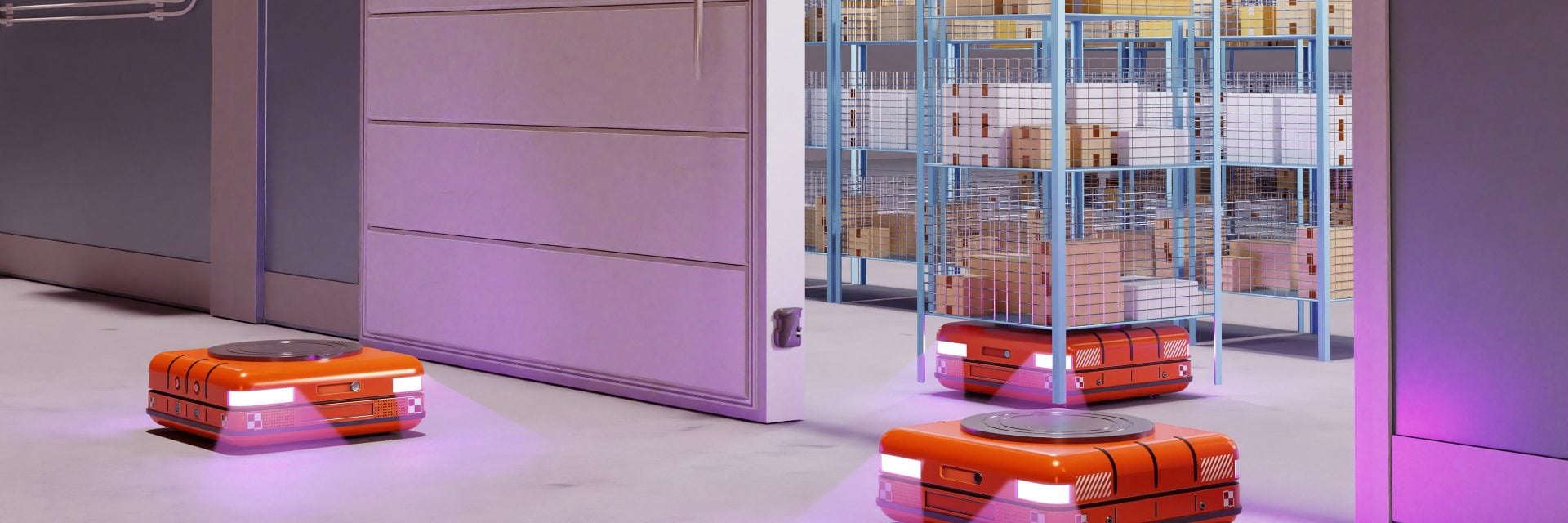
Designing the right MHE fleet for your biopharma operations
How a material handling equipment (MHE) simulation provides a better system design for efficiency and ROI
Read More