Batch vs. Continuous Manufacturing: Facility Design and Cost Comparison


For years, discussions around continuous bioprocessing have focused primarily on productivity, yield and process economics. While these factors remain important, today’s manufacturing leaders face a broader question: How realistically does process intensification influence the design, cost and long-term viability of an entire facility?
As continuous manufacturing technologies continue to develop and mature, organizations are evaluating whether conventional fed-batch production remains the optimal business approach for future facilities. The answer is rarely straightforward. The decision affects everything from bioreactor sizing and downstream purification strategy to facility footprint, utility requirements, capital investment and operational flexibility.

In our previous Insights article, Applying Continuous Chromatography for Process Intensification, we explored how integrating perfusion cell culture with continuous multi-column capture chromatography can improve resin utilization and increase manufacturing efficiency. The next logical question is how those process decisions affect the facility design and overall project cost.
Our latest case study expands the analysis beyond the process itself and evaluates the intensification implications for facility design, capital cost, operating expenses and construction considerations.
Looking beyond unit operations
Many evaluations of batch versus continuous manufacturing focus on individual technologies. Organizations compare bioreactors, chromatography systems, media requirements or automation platforms independently. While these comparisons provide valuable information, they often overlook the holistic impact these decisions have across an entire manufacturing operation.
The reality is that a shift to process intensification alters much more than equipment selection:
- Production suite sizing
- Utility demands
- Solution preparation and distribution strategies
- Warehouse requirements
- Utility loads and building utilization
- Process flow and material movement
- Building footprint and overall facility volume
As a result, manufacturing leaders evaluating future capacity investments must understand not only the process benefits of continuous operations, but also how those benefits translate into facility-level outcomes. It is important to recognize that facilities designed for intensified biomanufacturing must be purpose-built for this operating model. Facility designs optimized for traditional batch processing and intensified manufacturing are fundamentally different and cannot be expected to support both approaches with the same equipment configuration. As a result, organizations must make a deliberate choice between batch and intensified production strategies when planning future biomanufacturing facilities.
The evolution of process intensification
Interest in process intensification continues to grow across biotech. Advances in perfusion cultures, continuous chromatography, automation and process analytical technologies are making continuous operations increasingly viable for commercial manufacturers.
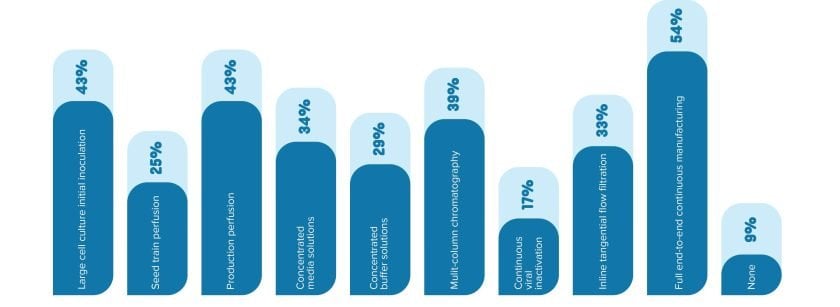
How rapidly is the industry pursuing process intensification?
According to CRB’s Horizons: Life Sciences 2025 report, manufacturers across biologics, ADCs and oligonucleotides are rapidly expanding investments in continuous manufacturing, inline technologies and intensified processing strategies.
See how peer organizations are approaching process intensification and where the industry is headed next.
However, many organizations are not pursuing fully continuous, end-to-end manufacturing today. Instead, they are adopting hybrid approaches that combine continuous and batch operations in ways that balance risk, operational familiarity and regulatory considerations.
This raises an important question: What level of benefit can manufacturers realize through selective process intensification before fully continuous manufacturing becomes standard practice?
The answer requires a detailed examination of how intensified upstream and downstream operations affect the broader manufacturing ecosystem.
Why chromatography remains a critical decision point
Capture chromatography is often one of the most influential areas in the batch-versus-continuous discussion.
In traditional fed-batch facilities, increasing upstream productivity typically drives larger chromatography columns, larger buffer volumes, additional infrastructure and greater operational complexity. As facilities scale, column packing, maintenance, storage and handling become increasingly significant considerations. Continuous multi-column chromatography changes that equation.
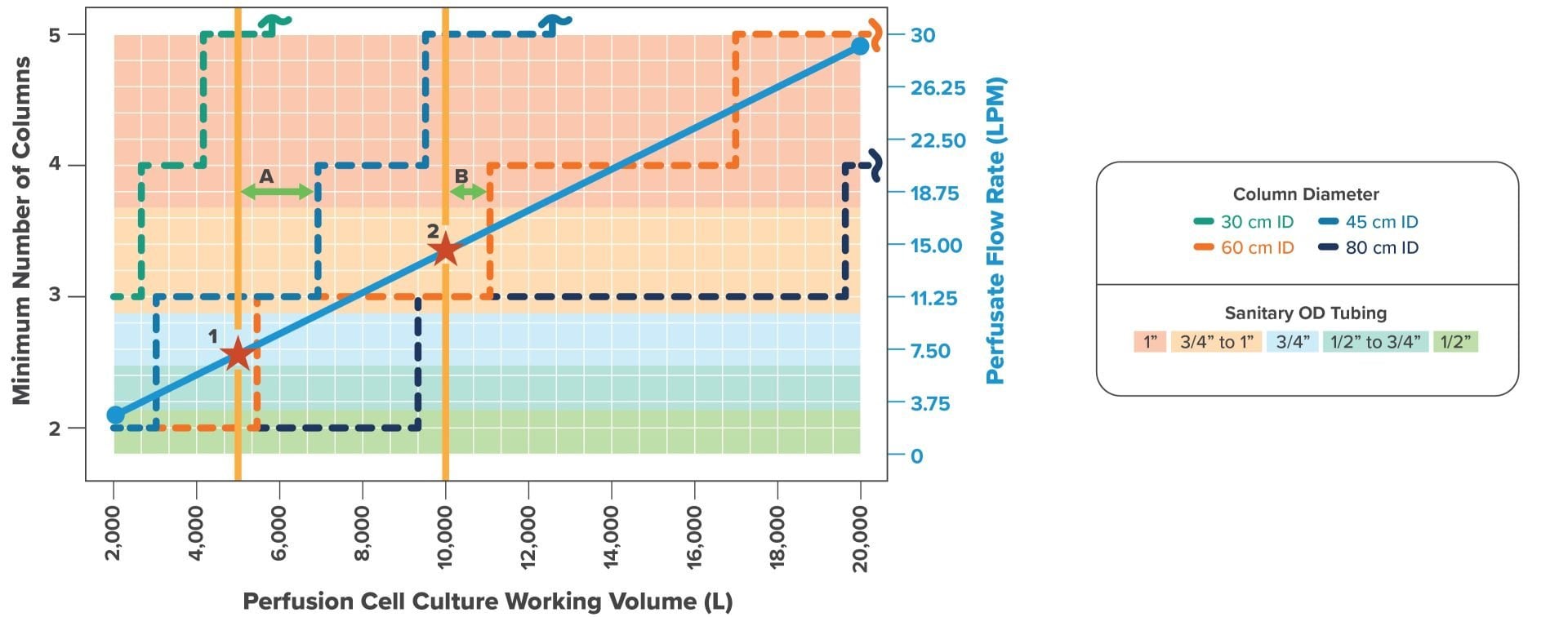
Rather than scaling by increasing column diameter, continuous systems can scale through additional columns operating in coordinated sequences. This approach can improve resin utilization while reducing dependence on large-scale chromatography infrastructure, including column packing complexity and column transport.
For facility teams, the implications extend beyond process performance. Changes in chromatography strategy can influence equipment layouts, support spaces, utility requirements, maintenance activities and overall building design.
Understanding those relationships is becoming increasingly important as manufacturers seek to balance throughput, flexibility and capital efficiency.
The facility design question
One of the most overlooked aspects of process intensification is its potential impact on facility configuration.
Smaller process equipment can reduce the need for large support systems and extensive storage infrastructure. In some scenarios, this can fundamentally alter facility layouts and simplify manufacturing operations.
However, these benefits are not always intuitive.
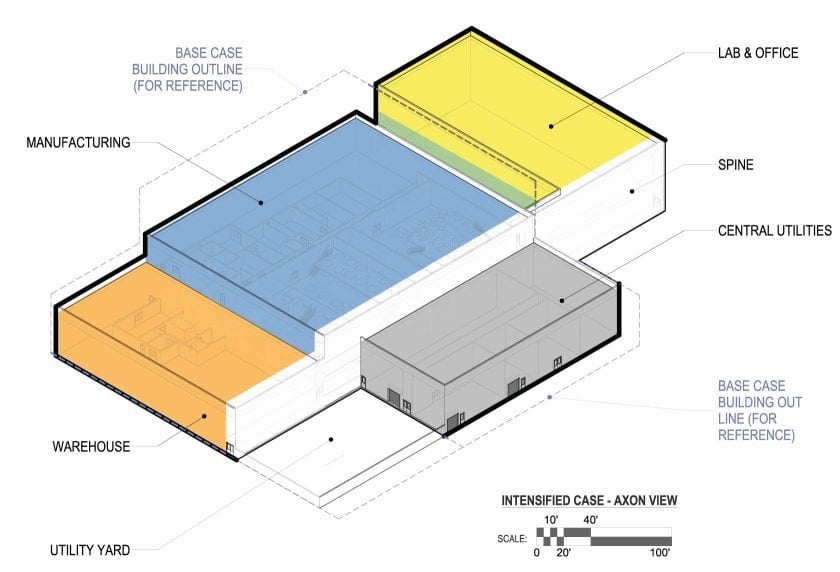
Continuous manufacturing often introduces new considerations, including:
- More complex automation requirements
- New process control strategies
- Continuous buffer delivery approaches
- Integration between upstream and downstream operations
- Increased emphasis on process monitoring and data management
The result is a complex tradeoff between equipment scale and operational sophistication.
Organizations evaluating future facilities need a framework for understanding where these tradeoffs create value and where they may introduce additional complexity.
Capital and operating cost considerations
Cost discussions around continuous manufacturing are frequently reduced to simple comparisons of equipment or consumables. It’s much more nuanced than that.
While intensified processes may increase certain upstream costs, they can also reduce costs elsewhere through improved utilization of expensive raw materials and more efficient downstream operations.
Similarly, capital investment decisions should account for more than equipment purchases alone. Facility footprint, utilities and project execution costs can significantly influence the overall business case. For example, the overall project timeline for an intensified biomanufacturing facility is typically shorter than that of a conventional batch facility, including the time required to complete Operational Qualification (OQ). If the intensified facility achieves licensure even a few months ahead of the batch facility schedule, the resulting head start in product revenue could exceed the total cost of the project.
For manufacturers planning new facilities or major expansions, understanding these interconnected cost drivers is often more valuable than evaluating any single process parameter in isolation.
Continuous manufacturing vs. batch manufacturing: A comparison of strategies
To better understand these dynamics, we developed a facility-scale comparison between conventional batch manufacturing and an intensified manufacturing approach that integrates perfusion cell culture with continuous multi-column capture chromatography.
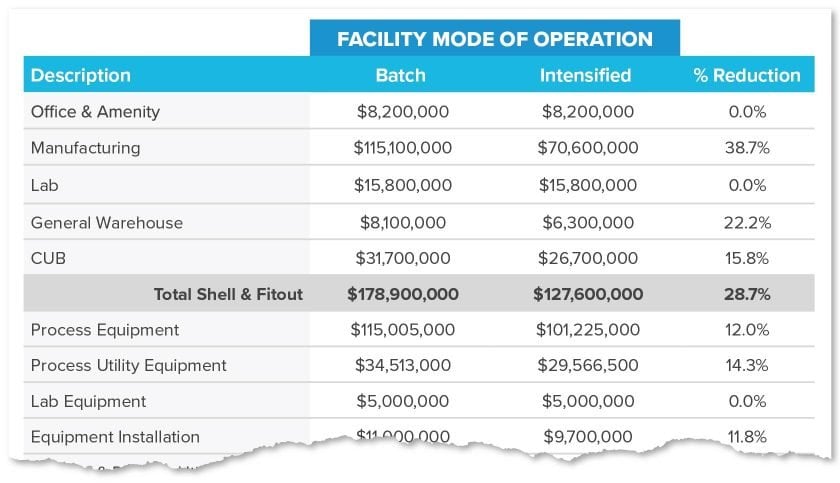
The analysis examines how each strategy affects:
- Equipment requirements
- Operating costs
- Facility layouts
- Building footprint
- Utility infrastructure
- Capital project costs
- Future scalability considerations
Importantly, the comparison maintains equivalent annual production targets across both scenarios, allowing manufacturers to evaluate differences on a consistent basis.
Rather than focusing solely on theoretical advantages, the study explores how process choices translate into real-world facility outcomes.
Download the Impacts of Process Intensification case study
As continuous manufacturing continues to evolve, the most important question may no longer be whether process intensification is technically feasible. Instead, manufacturers must determine where and how intensified operations create meaningful value across the entire facility lifecycle, and when to implement.
Our latest case study provides a data-driven comparison of batch and continuous manufacturing strategies, helping engineering, process development and manufacturing leaders evaluate the facility, cost and operational implications of each approach.
Download the full case study to explore the detailed analysis, facility concepts and cost comparisons that support informed manufacturing strategy decisions.
What you’ll find in the case study
The downloadable case study provides a realistic detailed technical evaluation of batch and intensified manufacturing approaches, including:
- Process flow comparisons for upstream and downstream operations
- Equipment-by-equipment capital cost analysis
- Operational cost assessments across key manufacturing functions
- Facility design concepts and architectural layouts
- Building footprint and volume comparisons
- Project cost modeling and construction implications
- Future considerations for end-to-end continuous manufacturing
The study also builds directly on the concepts introduced in our previous article, Applying Continuous Chromatography for Process Intensification, providing an in-depth look at continuous technologies and the role they may play in the future of biopharmaceutical manufacturing.
Frequently Asked Questions
Batch manufacturing produces biologics in discrete production runs, with each step completed before material moves to the next stage. Continuous manufacturing enables material to flow through connected unit operations with minimal interruptions, creating a more integrated production process. While batch manufacturing remains the industry standard, continuous manufacturing can improve productivity, reduce equipment size and increase process efficiency when appropriately implemented.
Continuous manufacturing can significantly influence facility design by reducing equipment scale, minimizing intermediate storage requirements and streamlining process flows. Facilities designed for continuous operations often require less manufacturing space, smaller utility systems, and fewer material handling activities. However, they may require more advanced automation, process controls and data management systems to support continuous operation and product quality monitoring.
Process intensification has the potential to reduce biomanufacturing facility costs by increasing productivity while using smaller equipment and a reduced facility footprint. Lower capital expenditures may result from reduced building size, utility demand and process infrastructure requirements. Operational savings can also be achieved through improved resource utilization, reduced buffer and media consumption and more efficient manufacturing workflows. Actual cost benefits depend on the process, product and facility strategy.
Continuous manufacturing can provide several facility-level benefits, including smaller manufacturing footprints, reduced utility requirements, improved equipment utilization and greater production capacity within the same facility size. Continuous operations may also support sustainability goals by reducing water, energy and raw material consumption. For many manufacturers, these benefits can translate into lower capital investment requirements and increased operational flexibility.
Continuous chromatography can reduce facility footprint by enabling higher resin utilization and smaller chromatography systems compared to traditional batch operations. Instead of relying on large-scale columns and extensive support infrastructure, continuous systems often use multiple smaller columns operating in sequence. This can reduce equipment size, simplify facility layouts, decrease storage requirements and lower the overall space needed for downstream processing operations.


An introduction to modern monoclonal antibody manufacturing
An in-depth review of what a monoclonal antibody is, how it’s produced and the challenges the industry faces.
Read More