
Why electric boilers should be a last resort to sustainability—and how you can further decarbonize your pharma facility through a sustainable heating design.
Read More
Traditional commercial-scale heating and cooling systems are a major source of emissions in the life science industry. For pharma manufacturers facing ambitious sustainability targets, rethinking these systems is a priority—get them right, and you’ll see significant progress toward your zero carbon KPIs.
However, without a strong business case driving the push away from gas-fueled heating systems, many operations and facilities teams find themselves caught between competing priorities: sustainability vs. cost control. But heat pumps are actively bridging the two with a surprising ROI.
Why use heat pumps in biopharma?
Example #1: Air-water-water heat pump for greenfield design
For one sustainability and cost-conscious CGMP biotech manufacturing greenfield project, CRB’s sustainability team designed a zero-carbon facility based on an energy-efficient air-water-water heat pump system. The heat pump created a zero-water central plant that eliminated the need for 24/7 boiler staff, cooling towers, and chemical treatments while reducing maintenance needs, labor training hours and EHS risks.
- In combination with energy conservation practices, the site reduced energy costs by one-third and saved 12 million gallons of water a year.
Example #2: Heat recovery chillers at all-electric facility
At a different sustainable biopharma site, CRB’s experts provided an all-electric design with heat recovery chillers modeled to handle the majority of the site’s heating loads. The greenfield design paired this cleaner heating approach with site-wide energy and water conservation best practices.
- As a result of these measures, the site reduced its carbon footprint by 50% and its water consumption by 40% when compared to similar sites.
Example #3: Replacing an existing chiller system
In the detailed case study below, you’ll see how a pharma site found huge gains by carefully examining its alternative heating options when updating equipment at an existing operational site.
- Now, the site is looking forward to a 600% increase in efficiency and a 75% reduction in natural gas use by replacing an aging gas-fueled boiler with a heat pump system. Skip ahead to the case study.
Benefits of efficient heat pump systems
Versatile, reliable, and highly energy efficient, commercial-scale heat pump systems address many of the environmental challenges levied by traditional systems while lowering operational spending. They achieve this outcome by extracting existing heat from the environment rather than using considerable energy to generate it through combustion.
The result can be extraordinary:
Energy savings
Facility owners who complete the preliminary groundwork to establish ideal conditions for their heat pump system could increase efficiencies by up to 800% (compared to a more traditional gas-fueled system).
Lower impact on the environment
Manufacturers need solutions that do not emit onsite (Scope 1) greenhouse gasses and that are fueled by cleaner energy. Heat pump systems have the potential to tick both boxes, although care must be taken to mitigate the risk of a leak that could expose the environment to harmful refrigerants and elevate the site’s Scope 1 emissions.
Regulatory alignment and future readiness
Many states are tightening their restrictions on carbon emissions, with others following. Some Authorities Having Jurisdiction (AHJs) are getting even more specific by limiting the use of commercial-scale electric resistance boilers which fail to meet efficiency standards. Regulations like these are driving owners towards highly efficient alternatives–in other words, heat pumps. By getting ahead of these changes now, owners can avoid costly retrofits in the future.

Types of heat pump technologies
There are several types of heat pump options to benefit different designs and system needs, including:
- Ground-source heat pumps (GSHPs)
- Air-source heat pumps (ASHPs)
- Water-source heat pumps (WSHPs)
- Air-Water-Water heat pumps (AWWHPs)
- Water-to-water heat pumps (WWHPs)
- Heat recovery chillers (HRC)
- Dedicated heat recovery chillers (DHR)
- 2-pipe / 4-pipe / 6-pipe configurations
Despite these strong benefits and system options, the life science industry is still generally reluctant to embrace heat pump technology. In my conversations with facility engineers, I often hear a few main concerns:
- “We have always relied on high-capacity, high-temperature systems to run our operation.”
- “Heat pumps won’t keep us within our target temperature ranges.”
- “We aren’t sure that the sustainability gains justify the initial capital expense.”
These concerns are legitimate—in a way. Manufacturers who swap their existing system for heat pump technology without making any other changes will likely face trouble. Proper heat pump planning takes time, commitment, and a shift in mindset to prepare a facility for the heat pump implementation. Operations teams who do this groundwork will find their investment rewarded from a business and sustainability perspective.
Heat pump planning
The groundwork involves a four-part energy conservation strategy:
- Collect annualized trend data → to right-size your relatively expensive alternative heating and cooling system according to actual utility needs.
- Lower your heating hot water temperature to a minimum threshold → to lay the groundwork for more efficient and commercially available alternative equipment.
- Untether central plant steam → to reduce reliance on steam generation systems that offer poor efficiency outcomes.
- Continuously review energy conservation measures under different lenses → to align business priorities with important sustainability targets, such as carbon and water reduction strategies.
As in the case study below, pharma manufacturers are applying this strategy right now, providing a glimpse of where the industry is heading—and positioning themselves for a low-carbon, high-efficiency, business-driven future of sustainable manufacturing.

Pharma case study: Heat pump technology reduces Scope 1 emissions at an existing site
A pharmaceutical leader aimed to reduce Scope 1 emissions by moving facilities away from traditional high-emitting systems toward efficient, modern technologies designed for long-term energy conservation. An aging chiller system at an existing site was quickly targeted for its inefficiency, water consumption and potential to reduce the heating system’s heavy reliance on fossil fuels from its heat rejection.
The operations team knew that by recovering heat emitted by the chilling process and repurposing it elsewhere, they could dramatically improve efficiencies and lower the site’s operating costs. Rather than perpetuate the status quo by replacing the aging system with something new but similar, the team turned to CRB to help evaluate sustainable options like heat pumps.
To reach that outcome, they had to overcome two key challenges:
- They did not have annualized day-to-day trend data.
- As a result, they could not say for certain how much heat was ejected by their chilling process, nor were they clear about how much heat their manufacturing process required.
- They were heating their hot water to the traditional standard 180°F.
- Although hotter than necessary, this temperature target had been in place for a long time—which made it difficult to change. But by lowering that threshold, this company would pave the way for an efficient heat pump system without impacting the quality and reliability of their operation.
The facility team did not have time to put their new heating system on hold as they addressed these challenges. Instead, while keeping their traditional system as a backup, we developed realistic projections of the facility’s future heating needs. The question was, “How efficient can this facility be if we apply the four-part energy conservation strategy, and what type of heat pump system is appropriate in that future scenario?”
The project proceeded with CRB’s sustainability experts modeling multiple alternative heating strategies in detail:
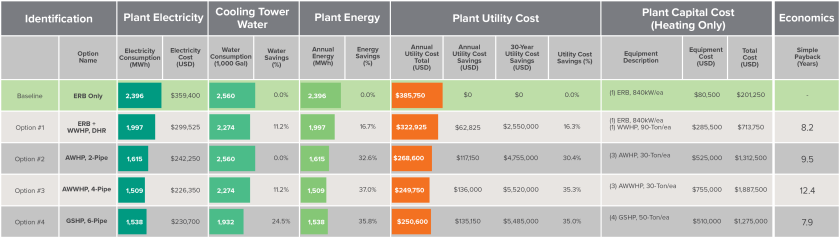
This model ranked each system according to quantifiable variables, but as any project team knows, there are important qualitative factors to consider as well. Some companies prioritize CapEx over OpEx savings, while others are focused on system simplicity and the push to reduce specific energy, carbon or water metrics as part of a site-specific or a company-wide initiative. For the team considering these heating pump options, as for any design team on the verge of an important capital spending decision, it’s important to weigh each of these factors appropriately.
A “Choosing by Advantage” framework can assist with this task. It’s a tool designed to help project delivery teams compare both objective and subjective criteria. In the case of this heat pump project, the team was able to score their sustainability goals, business drivers, and stakeholder preferences against each heat pump option.

Following this assessment, the pharma company elected to pursue Option #1, which uses a dedicated heat recovery water-to-water heat pump system for simultaneous heating and cooling. It’s a modular, indoor system with a Coefficient of Performance (COP) over 6.0—a 600% increase over the average natural gas boiler.
Option #1. WWHP, DHR
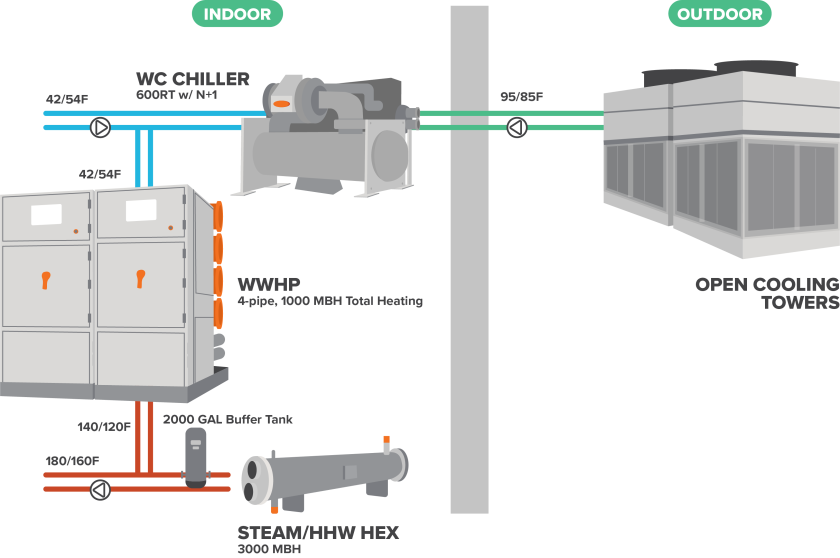
Benefits
- Indoor equipment
- Can optimize size with 12-month trend data
- Screw compressors available
- Efficiencies:
- WW CoP ~6.0 (simultaneous)
Drawbacks
- Partial capacity, limited to minimum winter cooling
- 25% turndown
As a result of this simple upgrade, the company will cut their on-site natural gas use by 75% (while retaining the existing system as a backup for the remaining 25% of the year)—no need to gut the whole system to unlock the majority of these efficiency rewards.
Had this facility team known further in advance that this project was on the horizon, they could have easily taken advantage of the recommended 4-part prework to maximize the system even further—potentially even getting to 100% zero carbon.

Creating efficient heating systems
Resilient business models that leverage sustainability as an economic driver—rather than simply a corporate responsibility—are the real key to hitting zero carbon KPIs. That’s what drove the cost-conscious, sustainability-focused biopharma owners whose stories opened this article. They significantly reduced both their consumption of resources and their operational spending by embracing right-sized, highly efficient heating systems as a part of their business model.
To follow in their example, facility teams need accurate equipment metering—because you can’t improve what you don’t measure. Accurate metering is possible with a relatively small upfront investment, and it will open the door to lower temperature thresholds, less reliance on steam, and other conservation strategies. These strategies lay the groundwork for a right-sized heat pump system optimized for year-round efficiency. The result is a lifetime of reduced capital and operational spending, with a much smaller cost to the environment.
Our team of sustainability experts can help you evaluate technologies to reduce emissions and transition your facility to a future of sustainable, business-driven manufacturing. Reach out to our Sustainability team today.

What is building energy modeling and is it worth it?
A detailed overview of how building energy modeling works with case studies and graphs.
Read More