


Digital transformation can boast significant production and efficiency gains, but is complex and multi-faceted, with different industries facing their own opportunities and challenges. Pharmaceutical companies are grappling with regulation and risk management, culture, security, and acquiring or creating the necessary skill sets. New processes and technologies can also put unexpected pressures on different parts of the organization. Pipeline setbacks, supply chain disruptions, and uncertain tariffs bring new levels of risk and uncertainty. Research and development (R&D) costs are rising, with new pharmaceutical treatments growing more complex.
The question becomes: Where do you invest in your manufacturing operations to ensure you’re moving forward, not falling behind? Fortunately, experts across our industry have developed frameworks and approaches to using technology to help overcome these challenges.
Why do a digital maturity assessment?
A digital maturity assessment is the first step for true digital transformation within pharma and biotech. The main purpose of this kind of assessment is to understand where digital transformation can deliver the strongest business value. Process inefficiencies, islands of automation, paper-based batch records—every pharmaceutical facility and process has its pain points, but you must understand them to solve them. A successful assessment will cover opportunities across the business―from control strategies to quality management, down to the foundational processes of an interconnected Pharma 4.0™ facility. Advancing your digital maturity can improve productivity, reduce human error, and minimize points of exposure, allowing you to put safety first as you get to market faster with continuous improvements.
A digital maturity assessment drives decision-making to ensure that progress is made and measured by:
- Preventing technology adoption concerns from obscuring business goals
- Identifying quick wins and the initiatives that will drive the greatest benefits
- Benchmarking against other manufacturers in the life sciences industry
- Benchmarking technologies and best practices from other industries
- Evaluating people and processes alongside technology
The more thoroughly that an organization uses facts to assess the financial benefits of digital transformation, the more confidence leaders will have in setting and pursuing ambitious yet realistic targets. Additionally, non-financial impacts can be evaluated, ensuring organizational transformation is understood alongside return on investment.
Embedding new digital technologies and capabilities in established assets and processes to increase efficiency, productivity, reliability, quality, and agility. It goes beyond simply using technology; it is about creating a data-driven culture, automating workflows, and building a flexible, integrated digital infrastructure.
Digitalization is the strategic and comprehensive process of leveraging digital technologies to enhance business processes, drive efficiency, and create new value.
Digitization is the conversion of analogue information into digital formats.
Defined by ISPE, Pharma 4.0TM is a broad vision of how the automation of processes and digitalization of systems can be applied specifically to the biopharmaceutical industry to drive a transformative improvement across the entire value chain with integrated ecosystems, smarter facilities, and processes that scale.
3 digital maturity assessments for biotech and pharma
Although assessments can be carried out informally, developed in-house, or use a proprietary 3rd party model – we’ve found that using standardized assessment tools offers far greater benefits. These assessments build on the insights of many experts, incorporating valuable considerations from other organizations, operations, and industries—allowing the pharma industry to learn and grow from outside experts. Standardized assessments cover a wide range of categories and levels of development, meaning they can assess what you’re doing now, but also grow with you, making it much easier to track progress. Crucially, the fact that they are standardized, means other organizations have gone through the exact same process, allowing you to benchmark your organization against competitors and partners, and the steps for improvement become much more valuable.
For pharma and biotech companies, there are three leading digital maturity assessments that we’ve seen deliver the greatest value:
Although each model has its own slightly different definitions, rating system, and areas of focus, in each assessment, you’ll find familiar elements from modern biopharma facilities in each of the three digital maturity assessments. Below is a deeper dive into each of these assessments.
1. BioPhorum Digital Plant Maturity Model (DPMM)
The BioPhorum DPMM was the life science industry’s first major digital maturity assessment, originally released in 2019 and currently on Version 3. It’s designed to build awareness and understanding of your current digital maturity state and help you build a roadmap to a desired future state. Today, the DPMM is the most widely used model in life sciences, used by approximately 70% of our clients.
This assessment typically takes one to two days, with 10-15 stakeholders from various departments (Ops, Engineering, QA, IT, etc.) in a room to reach a consensus. There are five levels of ‘digital maturity’ across dozens of business capabilities, each with distinct characteristics. Once you’ve determined what level your organization is currently at, you can set target levels you’d like to reach.
- Level 1: Pre-digital plant. Paper-based, manual processes (your typical facility of the 1990s).
- Level 2: Digital silos. PLCs and HMIs are implemented, but systems do not talk to each other, creating “islands of automation.” Manual data transcription is still required.
- Level 3: Connected plant. Vertical and horizontal integration. Systems share data interoperability.
- Level 4: Predictive plant. Real-time data usage. The system can predict the state of the facility hours or days in advance to inform decision-making.
- Level 5: Adaptive plant. Automated closed loops. The system not only predicts issues but automatically adjusts parameters to correct them without human intervention.
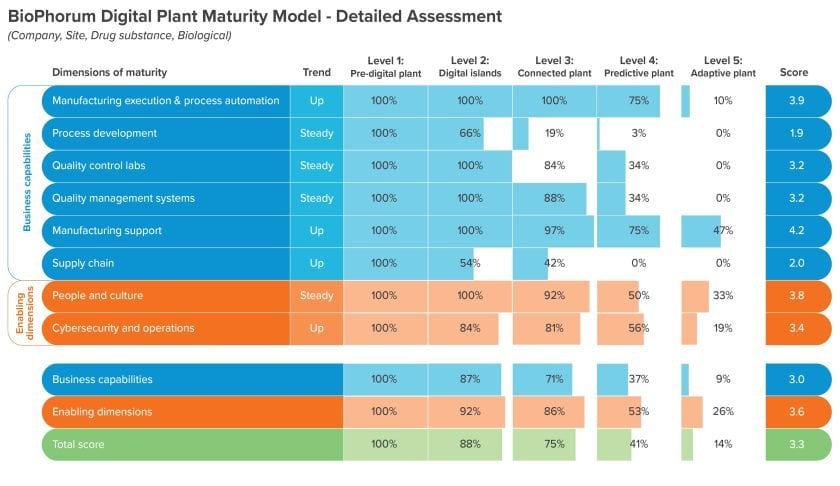
The reality is that most pharma plants are working towards an overall Level 3, with specific dimensions ranging between levels 2 and 4. You don’t need to reach 100% in one level to begin moving towards the next one. Most often, Level 5 will be out of reach for an organization, but it can be enormously helpful to have your assessment team think about what’s possible and what kind of goals might be worth working towards next.
The BioPhorum Model uniquely recognizes “shades of gray” exist within digital transformation: not everything is simply an integer between 1 and 5 – there is valuable room in between. This makes it much easier to assess capabilities at a granular level and measure smaller changes.
2. ISPE Pharma 4.0™ Maturity Assessment
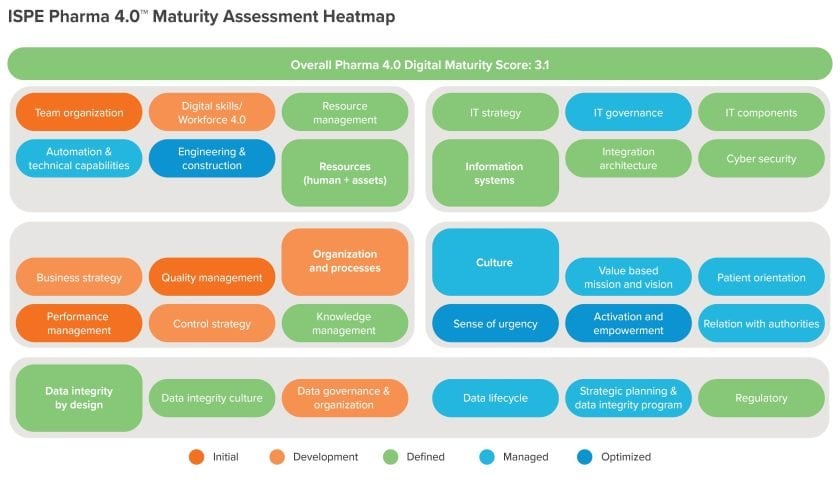
This newer model was developed specifically to address the unique needs of the pharmaceutical industry, incorporating regulatory and cultural aspects often missed by broader assessment models, like SIRI. This pharma-specific assessment is experiencing rapid growth, building on initial survey data with new research, parameters, and insights, such as recommendations for strategic hiring.
This assessment looks at maturity based on a holistic view of an organization along the five key elements of the ISPE Pharma 4.0 Operating Model:
- Resources: Digitalization of the workforce and assets
- Information Systems: Holistic value network, integration, and traceability
- Culture: Communication, decision-making, and values
- Organization: Lifecycle management and holistic control strategies
- Data Integrity
Unlike SIRI, this assessment makes data integrity a core principle, evaluating it with a unique biopharma lens across multiple categories.
3. Smart Industry Readiness Index (SIRI)
SIRI was developed by the Singapore Economic Development Board in collaboration with the World Economic Forum, manufacturers from different industries, consulting firms, and technology partners. Unlike BioPhorum or ISPE, SIRI is industry-agnostic, allowing pharma companies to benchmark themselves against other adjacent-but-relevant manufacturing sectors like automotive, consumer packaged goods, and electronics. There are 16 key dimensions that are assessed, categorized according to process, technology, and organization. SIRI benchmarking is anonymous, and the knowledge database grows increasingly robust with more submissions over time.
In SIRI assessment debriefings, more time is often spent on the benchmarking, as teams typically want to know how they are doing compared to peers and leaders in their industry and beyond. Of the three, SIRI is the only one with these kinds of comparable KPIs, allowing you to assess if your supply chain is “pharma good” or “Amazon good?” This can also create opportunities for the cross-pollination of ideas and solutions, especially from industries without the requirements and constraints of Life Science industries. What are the strengths of automotive manufacturing that allow just-in-time production? What can a robotics-forward semiconductor facility teach us?
Project example: CRB’s team benchmarked three factory’s digital standing against competitors with SIRI.
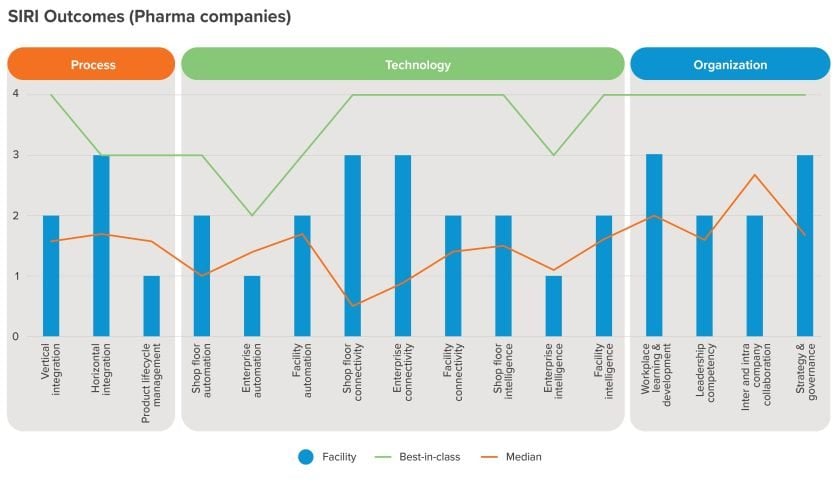

Companies often find it challenging to prioritize Industry 4.0 focus areas, making the TIER prioritization matrix another valuable outcome of a SIRI assessment. This decision-making tool is based on industry reports, landscape studies, business surveys, and models produced by leading associations and industry players along with more than 200 case studies. It builds on the assessment results and adds in context from revenue-cost profiles, key performance indicators, and industry benchmarks. A company and team that knows what the best-in-class looks like has a better sense of what is achievable and realistic, making them better able to set pragmatic goals.
While this cross-industry perspective is valuable, there are potential limitations for pharmaceutical companies. While SIRI can offer nuanced information and recommendations on things like machine learning, ERP systems, and supply chain integration, it misses pharma-specific regulatory realities, like data integrity, which can dramatically affect the cost-benefit ratios of each. While we recommend combining multiple assessment tools to get the best understanding of pharmaceutical facilities, this is especially true when it comes to SIRI.
Side-by-side comparison: Standardized digital maturity assessments for biopharma
| Feature | BioPhorum Digital Plant Maturity Model (DPMM) | ISPE Pharma 4.0 Maturity Assessment | Smart Industry Readiness Index (SIRI) |
| Primary focus | Technical roadmap
| Holistic organizational health check
| Global benchmarking
|
| Structure | 5 Levels
| 5 Elements
| 16 Dimensions
|
| Key output | Digital maturity scorecard
| Heat map
| Prioritization matrix
|
| Advantages | Biopharmaceutical-specific
Wide adoption
Granular
| Regulatory focus
Culture check
Aligned to best practices
| Wide benchmarking
Business focus
Universal
|
| Limitations | No benchmarking
| Newer
Complementary
| Misses regulatory nuance
Binary
|
| Best use case | Build a technical implementation roadmap for a specific manufacturing site and assess desired future state across specific business functions. | Assess organizational readiness, culture, and compliance before starting a digital transformation. | Prioritize investments and prove business value to the C-suite via objective global benchmarking. |
Digital maturity assessment: How it works

Step 1: Team assembly and alignment
First, and perhaps most importantly, you will assemble your team. A successful digital transformation absolutely depends on the human element for success. Only with a cross-functional, multiskilled team can you tackle the entire scope of the product lifecycle while giving stakeholders a voice and building consensus.
Multifaceted expertise
Ideally, your digital maturity assessment team will include experts in development, manufacturing, quality, engineering, IT, regulatory, supply chain, digital technology, connected health, statistics, market feedback, and sales. Depending on your facility, experts in other areas should be invited as appropriate. Bringing together diverse stakeholders to work through questions and discuss solutions will help everyone understand the project and remain committed to the process. Digital transformation is both organizational and technological change, and often technology is the easy part. Convincing people to change how they work can be the hard part. Even ISPE research has shown how “fear of change” is a real barrier to digital transformation, making openness and collaboration essential to success.
External insight
In almost every case, we recommend bringing in an external consultant to lead your assessments. This allows your entire team to focus on contributing to the assessment instead of managing the process. It is also an additional way to bring in unbiased expertise and a bigger picture to the process. Having experience with dozens of other companies navigating this process, an experienced facilitator can maximize the impact of the workshop, bringing in examples and experience turning buzzwords into tangible business impacts. Using external facilitators also ensures a consistent approach and standards across facilities and projects going forward.
Preparatory information gathering
Prior to the workshop, we recommend conducting a questionnaire for all participants. This gets them aligned on digital transformation and what success might look like: What are their pain points? What would they like to improve within the organization? You don’t want to just find out where you are; you will decide where you want to go, based on the business value. Adopting new technology is most effective when it solves specific pain points. It’s important to begin the process by observing participants and understanding their needs before talking about solutions.

Step 2: Maturity assessment workshop
Once you know the assessment(s) you want to use, it’s time to plan the workshop. This is a high-value, low-impact process. The most difficult part is getting everyone in the room, but the consensus-building is invaluable.
Short and intensive
Assessments are designed for minimal disruption of normal operations and can be completed in a short time. This typically requires only two days from your team over two weeks, as the internal or external facilitator sets the scope, gathers information, and creates the assessment report. The assessor will keep you informed about the process, required documents, and areas to be reviewed, ensuring a thorough and accurate evaluation of your organization’s Industry 4.0 readiness.
Focus on tangible outcomes
The workshop itself will depend on which assessments are being performed. Still, there will be the establishment of goals, business drivers, and objectives, as well as urgent pain points and consistent challenges. Specific, tangible information increases the likelihood that roadmaps are immediately actionable, and often the workshop is further grounded with discussions of current projects and even a tour of the facility and conversations with operators. Afterwards, the assessor will score according to assessment criteria and help the group review and align on the results.
Consider combining assessments
Each maturity model has its own strengths and weaknesses, making it more difficult to determine in advance which one will provide the most insights for your facility―especially if you are just getting started on your digital transformation journey. Since coordinating calendars is often one of the most difficult challenges in conducting an assessment, consider performing multiple assessments simultaneously during the same workshop. In practice, it will only add an incremental amount of work and can deliver more value and even unexpected insights. For example, data integrity insights from the ISPE assessment can often align with the vertical integration dimension from the SIRI model, offering a clearer strategic picture.
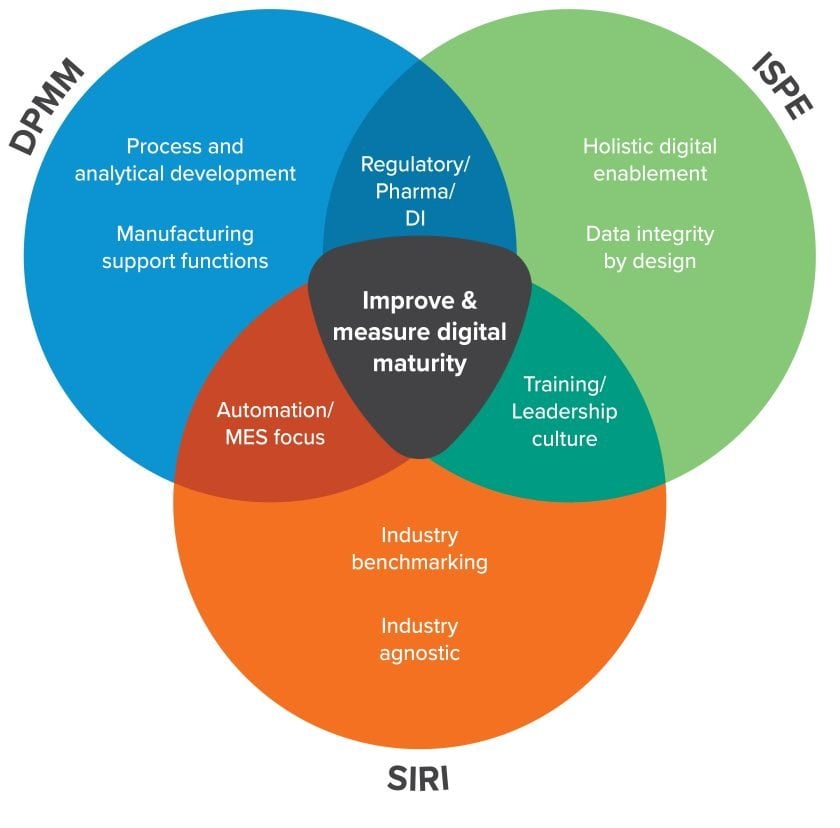
Digital assessments can be far more effective together:
- Use SIRI to benchmark your facility against the world and identify high-level priorities. Best for high-level benchmarking against the world and prioritizing investments based on cost/KPI impact.
- Use BioPhorum (DPMM) to build the specific technical roadmap for those priorities. This is best for a detailed, technical roadmap specific to life sciences. It allows for nuance (e.g., you can be a “Level 2.5”).
- Use ISPE to ensure your culture and data integrity standards are robust enough to support the new technology. Best for checking the “health” of your organization’s culture and data integrity compliance in a pharma-specific context. Once you’ve determined what level your organization is currently at, you can set a target level you’d like to reach.
Documentation and visible tracking of decisions will help everyone understand their shared responsibility for change. Assessment results include visual tools to make results easier to communicate to leadership and other stakeholders, protecting the investment in the whole process by ensuring that workshop results live long past the workshop itself.

Step 3: Drawing a roadmap
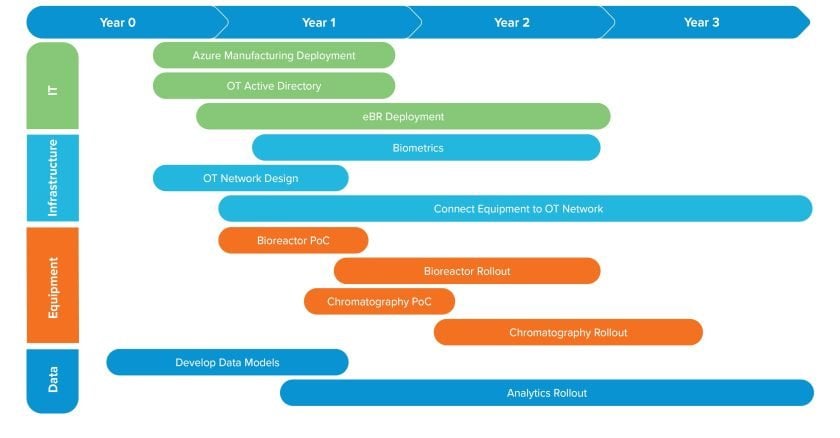
To reach your target level and further transition towards Pharma 4.0, your organization will need to turn the output of the digital maturity assessment into a plan for action. This is where you turn your goals into specific projects.
This is why ISPE, in coordination with many industry players (including experts from CRB), developed the Pharma 4.0 Operating Model. This approach considers key challenges and suggests how pharmaceutical companies can benefit from new technologies like machine learning, AI, and process analysis while meeting their regulatory, safety, and security needs. For both companies and the industry to thrive, facilities must not only keep pace with each other but also with partners across the value chain—from drug development to materials and packaging.
A digital roadmap includes:
- Desired capabilities and technologies
- Key enablers, vendors, and infrastructure
- Business impacts (ROI / NPV, KPI, etc.)
- Pilot opportunities and roll-out strategies
Pick low-hanging fruit
To formulate effective roadmaps, prioritization is a crucial exercise as it helps companies identify business areas where improvements will generate the most value. This is where tools like the TIER matrix, that’s part of the SIRI assessment, can help you get started. We’ve found that introducing new technology works best when applied to specific problem areas or meaningful use cases.
There are several factors across your facility and operations to balance when choosing which initiatives to pursue:
- Technologies and vendors currently available
- Competitive pressures and industry trends
- Needs of partners and contractors
- Workforce development
- Cybersecurity and product safety
- Financial impacts and risks
- Efficiency and materials
Start small. Don’t try to change everything at once. Pick a pilot project, make small wins, prove the value, and assign a dedicated owner who is held accountable for that specific success. Not every potential initiative will have the ROI you need. The clarity and context offered by an assessment will prove invaluable in making informed investment choices. Choosing those with maximum impact and a high chance of success will allow you to generate wins and momentum.
Assign a single business owner
Depending on the breadth and depth of a digital transformation initiative, it may be worth considering assigning a single person to be accountable for the overall performance and outcomes of the process. This person becomes the single point of contact for stakeholders, bearing the responsibility for ensuring that the process meets the established key performance indicators (KPIs) and achieves the desired objectives. Also, this owner can help prevent overlaps and conflicts between individual projects. Process owners are champions of continuous improvement, gathering feedback, and constantly seeking opportunities to enhance the efficiency, effectiveness, and agility of the processes under their purview.
Measure progress and count successes
Digital transformation is a challenging process. Research from Boston Consulting Group indicates that most organizations (as much as 70% across industries) do not achieve their transformation objectives, and those who do have difficulty sustaining their successes.
Effectively monitoring progress toward defined outcomes was a critical factor among those who succeeded. Measuring progress is a critical and multi-faceted exercise. You need a holistic view of the overall transformation and granular attention to the individual initiatives and components that make it up. It is not enough to track implementation progress: you want to measure against the original strategic intent and KPIs established at the outset of the digital maturity assessment and roadmap. It’s not “system launched” or “training completed,” it’s “% cost decrease” or “X of product produced.”
Therefore, the final step in the digital maturity journey is rigorous, continuous measurement, focusing relentlessly on the achievement of strategic business outcomes, which are the ultimate indicators of successful transformation. While achieving Pharma 4.0 may come with challenges, creating a sustainable, step-by-step roadmap will help your organization avoid common pain points experienced when introducing new technologies.
This ensures business value for each recommendation, and drives concrete, measurable business decisions to deliver that value.
Additional pharma and biotech industry tools to support digital transformation projects:

Step 4: Keep the progress going!
Even if a workshop lasts only a day or two, its impact will last much longer. A full data transformation effort may take months or even years, and the benefits can pay off for decades. That’s a promising investment. To protect all this excellent work, you’ll want to continue assessing your current status and future goals. You may not need to redo each full assessment but revisiting and revising results every year can give you a much stronger sense of progress and prevent technological debt, scope creep, and other challenges that often build slowly and can be hard to catch otherwise.
The journey to Pharma 4.0 may seem daunting, but the benefits and exciting opportunities created by increased efficiency, accuracy, and safety within your facility are vast. Because there are so many technologies you can add to your digital transformation roadmap, it’s crucial to identify which work best for your specific goals and what you can integrate at a sustainable level.
Need help with your digital maturity assessment?
Our experts work with biotech and pharma clients around the world to identify digitalization opportunities using the DPMM, SIRI, and ISPE digital maturity assessments, making financially-driven, practical, and impactful recommendations.
If you would like biopharma-specific guidance outlining your roadmap or determining your next steps, let’s talk.


Intro to Pharma 4.0™ and facility digitalization
A user-friendly roadmap to Pharma 4.0™ technologies and applications and webinar filled with Pharma 4.0 examples.
Read More