SIRI digital maturity assessment identifies manufacturing priorities and strengths
Manufacturing companies have long benchmarked themselves against industry peers using a combination of industry reports and performance metrics like OEE (overall equipment effectiveness). This strategic practice enables manufacturers to be more competitive while developing a tailored improvement path. But what happens when you want to understand your competitive standing in a fast-evolving space swarming with Industry 4.0 buzzwords?
The challenge: How to benchmark a factory’s digital standing against competitors?
How do you compare a semi-automated factory floor to the wider industry’s factory operations amid constant change and closely guarded secrets?
A confidential manufacturing client turned to CRB to do just that, knowing that benchmarking Industry 4.0 against competitors would be tricky but extremely advantageous from a business perspective.
The approach: A level-setting 4.0 assessment for manufacturing insights
Within just a few weeks, CRB gathered data, conducted workshops, and completed a SIRI (Smart Industry Readiness Index) digital maturity assessment for three of the client’s sites. This study allowed the client team to understand how they compare within their specific manufacturing sector across 16 different dimensions, including vertical integration, supply chain, automation, connectivity, strategy, governance and more.
The bulk of the work was completed collaboratively during on-site workshops, consisting of an end-to-end factory assessment, an open conversation about current pain points and ongoing improvement projects, and active rating discussions on each of the 16 dimensions. By utilizing a Certified SIRI Assessment, the client could level-set its Industry 4.0 program against known industry standards and bring in ideas from outside the organization.
The three sites benchmarked were considered standard plant types with very different manufacturing operations. This allowed us to accurately benchmark the sites against their peers while internally benchmarking their performance and sharing best practices.
While our client ranked best in class in some areas, room for improvement was also identified. The benchmarking highlighted the relative size of the gaps and areas where internal best-in-class practices could be shared throughout the organization. Lastly, our Industry 4.0 Specialist outlined four principles for the client to consider as part of a prioritization exercise so the operations team could focus on the activities that will bring the greatest benefits relative to actual business goals.

Here is an example of a SIRI digital assessment for a pharma company:
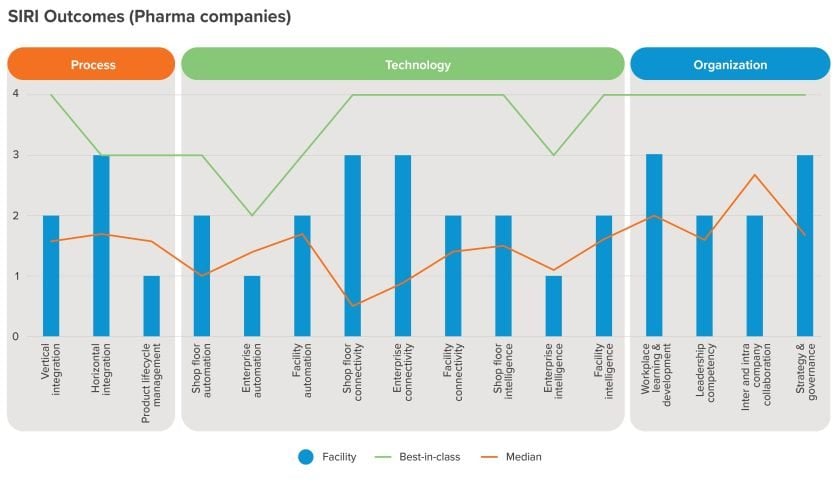
SIRI assessments are focused on digital maturity and Industry 4.0. The process is based on a framework developed by the International Society for Industrial Transformation, which helps move manufacturers away from buzzwords and instead leverages quantifiable benchmarks and areas for focused improvement. It is a low-risk tool designed to quickly allow factories to start tracking progress against operational goals and digital transformation plans.
SIRI is just one option for digital maturity assessments; ISPE and Biophorum have also developed versions of these tools. Depending on a company’s unique variables, one or a combination of these assessments might fit the intended goal and need.

The outcome: Qualitative alignment for management-planning
Ultimately, our Industry 4.0 study provided the client benchmarks for their bottom line, essential business objectives, and against their specific manufacturing community. We also provided a tool to translate prioritization into action. The output can act as a management-planning tool, identifying high priorities where Industry 4.0 improvements to processes, technology, and organization will bring the most benefit and generate the greatest value. The outputs from this quick study, include:
- Aligned strategic goals for digital transformation with site leadership
- Identified and prioritized potential high-impact areas
- Identified four focused areas of improvement that will deliver results against site cost profile, long-term KPIs, and industry benchmarks
How manual and labor-intensive is your factory compared to your competitors?
The answer likely requires help to sift through the hype and objectively compare aggregate data from similar companies. In doing so, you’ll first need to evaluate several aspects of your operations. You’ll, of course, want to examine your adoption of any automation and new robotics tools, but you’ll also need to explore your level of connectivity across the enterprise, employee skillsets, and the value of insights your data is actively providing.
The state of digital transformation is highly industry-specific, often heavily influenced by factors like the materials and volume of products, the complexity of manufacturing processes, regulations and competitive dynamics. The point of these benchmarks is to keep you competitive as the logistics and possibilities of manufacturing change, finding your greatest active opportunities for growth within your market. Benchmarking your current state is a quick but strong first step in your digital transformation roadmap.
If you’re ready to understand how your mix of manual and automated operations compares to your competitors and find your opportunities, let’s talk. Our consulting team has conducted SIRI assessments across multiple industries worldwide and is ready to get yours started, too.