Simulation cuts CIP media by 74% and energy by 50% while verifying design
Simulations solve a lot of problems across biotech operations, often verifying CapEx while increasing efficiency.
The manufacturing challenge:
A large biologics producer sought to upgrade three European-based manufacturing facilities to satisfy regulatory requirements, which required the team to make design and engineering changes. The manufacturer partnered with CRB’s consulting team to validate and optimize the new design configurations while verifying that the changes met regulations.
The client needed to:
- Validate new process designs against real-world data to ensure reliability and scalability
- Ensure the new design met regulation requirements
- Establish utility needs
A simulation-based approach:
CRB conducted workshops with the client’s engineering and production teams to better understand their needs and anticipated design changes, aligning on process logic, utility consumption, CIP philosophy and closed processing.
From this foundation, our team developed a detailed baseline process model. Resource consumption rates for key process steps were validated against historical usage for PW, NaOH, H2SO4, steam, caustic, acid, and buffers. The validated baseline model was used to evaluate multiple scenario‑based design options to quantify throughput and identify potential constraints. Additionally, we evaluated CIP utilization to support the client’s 24/7 operations for multiple products that the client produces across all three facilities.
Our process simulation experts then developed CIP circuits and distribution designs to reduce and mitigate potential process bottlenecks. Simulation recipes captured step-by-step production and CIP sequences for each major unit operation, including chromatography, precipitation, and mixing. Outputs provided comparable metrics on media consumption, draw rates, number of required CIP skids and impact on equipment utilization.
These simulations enabled us to compare alternative equipment configurations—including suspension dryers vs. traditional freeze dryers, various high-performance liquid chromatography (HPLC) column sizes, while assessing their impact on cost, throughput, equipment utilization, utilities, and overall manufacturing lead times.
Process simulation outcomes:
The process simulation study not only met the client’s needs, but it also achieved far more. Our team used simulations to quickly vet the design and verify the feasibility of design alternatives while providing associated cost estimates for informed decision-making, which supported conceptual and detailed design.

Client needs achieved:
- Validated new process designs, ensuring reliability and scalability
- Ensured design met regulatory needs
- A thorough understanding of utility needs

Additional CIP improvements:
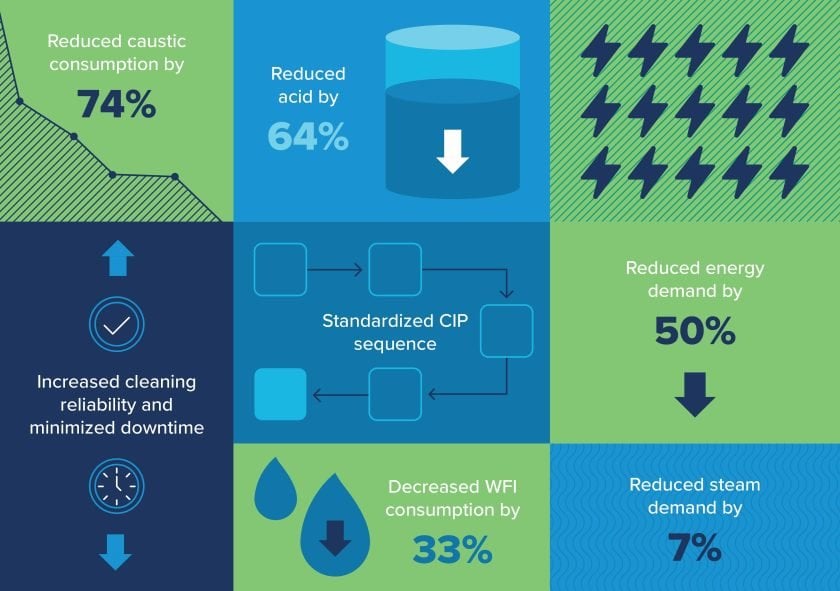
- Reduced caustic consumption by 74%, acid by 64%, and energy demand by 50% compared to the consumption of previous cleaning methods
- Standardized CIP sequence with dedicated units across all process areas
- Increased cleaning reliability and minimized downtime observed in legacy systems
- Decreased water for injection (WFI) consumption by 33%
- Reduced steam demand by 7%
Our consulting team provided clear data for facility stakeholders to move forward with CapEx plans with confidence amid changing regulatory needs. The study provided options across closed processing considering new technologies in freeze drying and material additions, sanitary design, material and utility usage and cost. Additionally, the model was structured for continuous improvement and ongoing refinement, allowing for model updates as new data and process changes emerge over time.
Ready to improve your manufacturing efficiency?
Let’s run a consulting study to see what your manufacturing solutions and gains could look like. Connect with our operations improvement experts now.