Air change rate study saves $1.3MM in CapEx, plus $80k annually
When a global pharmaceutical company partnered with CRB to develop a new 30,000-square-foot warehouse, the client’s design guidelines called for four air changes per hour to support the temperature-controlled facility. Based on past projects, CRB’s team of engineers suggested the 70° F ± 2°F warehouse’s needs could likely be achieved with less air change rates. If true, this could heavily reduce capital expenses, annual operating costs, and the facility’s carbon emissions. However, this theory needed to be thoroughly tested and proven before being incorporated into the warehouse’s design.
How do you test for temperature regulation in a warehouse that’s not built yet?
Luckily, CRB has a team of CFD experts who specialize in solving theoretical design questions like this. Computational fluid dynamics (CFD) provides a simulated space for the experimentation of air flows and temperatures based on the laws of physics, making it an excellent tool for validating design assumptions before making a financial commitment.
Air change rate validation process
To determine the necessary air change rates, our CFD team developed a detailed warehouse model and ran multiple scenarios.
- We developed a 3D CAD model of the warehouse, which included:
- Structural components, ductwork, and storage racking, to properly determine airflow patterns.
- Heat loads and heat flux conditions like concrete slabs and light fixtures.
- Operators, number of destratification fans, rack capacity and other related variables.
- The model’s supply airflow was set within the required ± 2°F range, and airflows and temperature distribution were calculated based on air mass, momentum, and energy balance.
- Two models were created to observe peak summer and peak winter conditions, factoring in the changing demands of extreme weather.
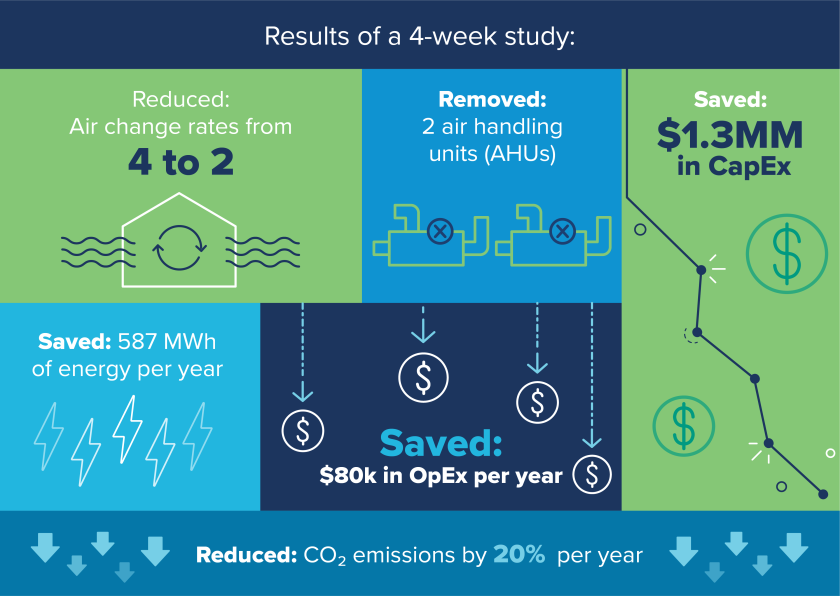
The energy saved, CO2 reduced, and ROI of reducing air change rates
The simulated CFD environment allowed us to experiment with fewer air handling units and a wide range of destratification fans to see if reduced air change rates were possible while maintaining the narrow temperature range. As a result of this 4-week simulation study, we were able to reduce the warehouse’s air change rates, remove two air handling units, four air-source heat pumps (ASHPs), and the space that equipment would have occupied, amounting to $1.3MM in capital savings for the client.
To take this study one step further, a CRB energy modeling specialist analyzed the associated operational savings for this air change rate reduction. The energy models found $80k in annual OpEx savings and a 20 percent reduction in CO2 emissions.
Need a CFD specialist for your project?
This is just one recent example of how our simulation engineers can support leaner designs and operations through validation. If you are adding, replacing, or modifying the equipment in your facility and want assurance in your investment, talk with our CFD consultants first.