

Spray drying is a reliable process to create high-quality pharmaceuticals—but precautions are needed.
Spray drying is a common practice in pharmaceutical manufacturing for the production of both the active pharmaceutical ingredient (API) and excipients.
When set up correctly with proper risk mitigation, spray drying is a predictable and reliable process to create high-quality pharmaceuticals. However, without proper risk mitigation, this process can potentially trigger a flash fire or explosion.
Here’s what to know about potential safety hazards around spray dryer operations, along with corresponding safety considerations, when using spray drying as part of oral solid dosage (OSD) operations.
Understanding the spray drying process
The spray drying process uses hot gas to produce dry powder from a liquid or slurry. It involves injecting liquid droplets into a hot gas stream. As the droplets pass through the drying chamber, the liquid phase evaporates, leaving solid powder. This powder then migrates to the bottom of the chamber and continues to be processed through downstream units.
Want to learn more about the spray drying process? Check out Spray drying solutions: Considerations for API and OSD processing operations.

Risks involved in a spray drying process
There are three main risks linked to the spray drying process:
- Flammable liquids
- Combustible powders
- Potent materials

Risks from use of flammable liquids
In most spray-drying processes, the target particle is suspended in a volatile organic solvent. Through the drying process, a flammable vapor atmosphere within the drying chamber—and possibly within the downstream units of the chamber (i.e., cyclones, bag filters, etc.)—can be created. This can pose a significant risk of fires and explosions.
The National Fire Protection Agency (NFPA) code defines a flammable liquid based upon the flash point and boiling point of that liquid. Commonly used solvents in the spray drying process are ethanol, methanol or acetone. These liquids have low explosive limits (LEL), which increases the efficiency of a spray drying process but also creates a flammability hazard.
Once the concentration of vapor within a closed system is sufficient, a flash fire or explosion can occur if the vapor is mixed with an oxidant and exposed to an ignition source.
Potential sources of ignition
The three elements of the fire triangle—fuel, oxygen, and heat—must be met to ignite and sustain the fire itself. Within the spray drying process, these are:
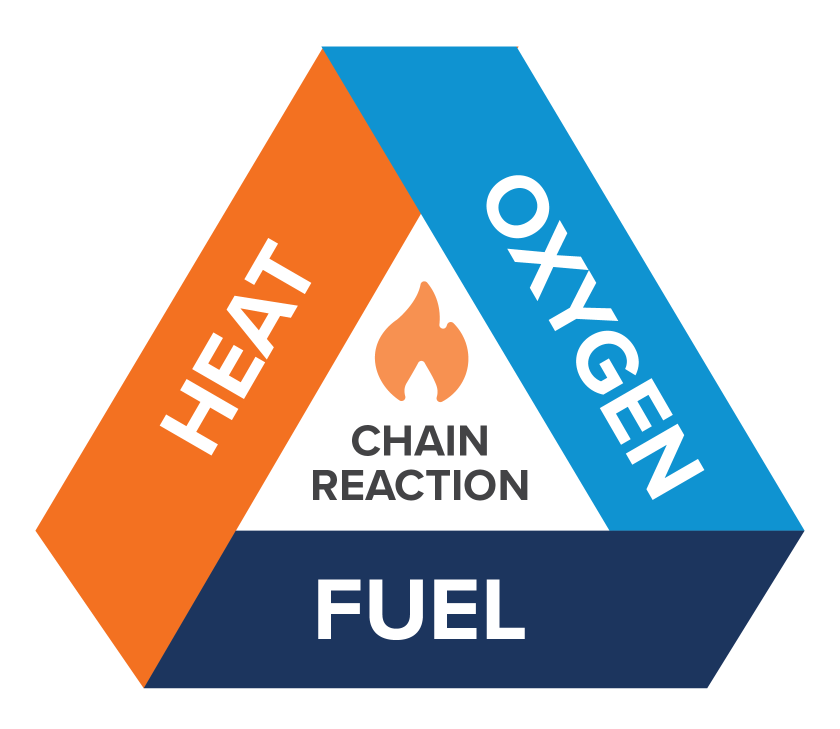
Fuel:
- Flammable liquids
- Combustible powders
- Vapor risks
Oxygen
Heat:
- Static electricity can be generated during the misting operation or when powder starts to accumulate at the bottom of the drying chamber.
- Friction can be caused by moving parts such as atomizers or rotary discs.
- Instrumentation can cause a sudden discharge of electricity between points with a potential difference.
- Manual intervention, such as opening the equipment and exposing it to air during, can cause a spark.
Recommendations to manage risks from flammable liquids
Manufacturers can support safe spray drying powder operations through precautionary measures.
Third-party testing
To prevent a fire, knowledge of the formulated solution, including the LEL of the solvent, is necessary. Since it’s common for a formulation to be a mixture of flammable liquids, this step may require third-party testing to determine an accurate flash point and boiling point of the liquid.
Oxygen reduction/elimination
The oxygen content within the process must be minimized to prevent the atmosphere from supporting combustion. Continuous oxygen monitoring with redundant sensors should be used to trigger inert gas (nitrogen) addition when levels rise. Implementing interlocks, alarms and an automatic nitrogen purge in response to oxygen depletion provides an additional layer of protection, ensuring oxygen levels remain safely within defined limits.
Electrical classification
Electrical equipment and instrumentation within the spray dryer and associated systems must comply with NFPA 70 (National Electrical Code) and NFPA 497 for hazardous location classification. Equipment should meet the appropriate Class I, Division rating to eliminate potential ignition sources. Rating instruments as intrinsically safe provides an additional layer of protection by preventing spark generation.

Risks from use of combustible powders
The nature of the spray drying process is to suspend a dust cloud within the drying chamber, cyclone separator and bag house filters. However, this setup can be sufficient to support a deflagration.
Separation of the solid phase from the carrier liquid, which can be flammable or non-flammable (aqueous) liquid, may result in the generation of a combustible powder. The presence of an aerosolized combustible powder or accumulation of the powder within the process can result in flash fires or explosions during drying operations.
Deflagration and detonation can occur when a dust cloud reaches a certain concentration level in the atmosphere, thereby becoming combustible. A combustible dust is defined as dust particles that are 500µm or smaller. This fine dust presents a flash-fire hazard or explosion hazard when dispersed and ignited in air (NFPA 499) due to their increased surface area.
Additionally, when deflagration occurs within a confined space, like the drying chamber, an increase in pressure may cause the enclosure to rupture.
Relevant factors:
A clear understanding of concepts like MEC, MIT, Kst, and Pmax is essential for evaluating explosion risk and designing effective controls.
- Minimum Explosible Concentration (MEC): The lowest concentration of dust in air that can support an explosion when ignited.
- Minimum Ignition Temperature (MIT): The lowest temperature at which a dust cloud or layer will ignite upon contact with a hot surface.
- Explosivity Index (Kst): A parameter that quantifies the rate of pressure rise during a dust explosion, used to assess the explosion’s severity.
- Maximum Pressure (Pmax): The highest pressure reached in a closed vessel during a dust deflagration under ideal conditions.
Recommendations to manage risk from combustible powders
There are many steps manufacturers can take to promote a safe working environment during spray drying powder operations when using combustible powders.
Third-party testing
Information on the properties of some powders is not readily available and highly dependent on its formulation and where the powder exists within the process. To determine the MEC and MIT and other relevant information, like the explosivity index (Kst) of a powder, a sample should be tested by a third-party laboratory.
Any additional processing of the powder, such as the collection of fines through downstream filtration, should also be submitted for third-party testing since further processing may alter its combustibility characteristics.
Venting
In instances where spray drying equipment may not be rated for containment of an explosion, special considerations need to be made for adequate venting or explosion prevention.
Electrical equipment
Installation of non-rated electrical equipment should be avoided in areas where combustible dust is present. A temperature and electrical classification should be given to any electrical equipment that must be installed within the space. The National Emergency Management Association (NEMA) has developed a rating system that enables end-users to select the proper enclosures for electrical equipment in hazardous locations.
Oxygen reduction/elimination
The oxygen content within the spray dry equipment must be reduced or eliminated such that the atmosphere within the equipment is incapable of supporting combustion. Special consideration should be given as oxygen could also be generated due to decomposition under the high temperatures of the drying process when bulk material is present. This requires specific knowledge of the product through all phases of the operation.
Control of ignition sources
Grounding the equipment and restricting the use of nonconductive materials can prevent the buildup of static electricity in powder collected within the dryer.
Ignition by a dust cloud can be eliminated by ensuring the air inlet temperature is less than the ignition temperature of the powders.
For powders that are thermally unstable or prone to decomposition at high temperatures, particularly when bulking occurs at the powder outlet, the installation of vibrators or pneumatic hammers on the side walls of the drying chamber, cyclone separators and bag filters can help ensure the material exits the dryer properly.
Solvents vs powders
Although safety measures for combustible powders can also apply to solvent-based spray dryer feed, there are important differences. With flammable solvents, a significant portion of the spray drying system can become hazardous, and certain areas may allow combustible dust to accumulate, requiring special attention.
Depending on the amount of product dried, flammable vapors can also be present in downstream equipment. To address this, additional drying systems such as post dryers or vacuum dryers are often used to remove residual solvent.

Risks from use of highly potent materials
Potent compounds have various methods for classification and typically are segregated into different containment classifications based on the concentration at which an individual can be exposed to a specified amount of time (typically 8 hours in a day or 40 hours a week) without having an impact on their health.
A potent compound is defined as one with an OEL ≤ 10 µg/m³ (time-weighted average over an 8-hour a day exposure) and an occupational exposure band (OEB) of 4 or above.
APIs that are potent and toxic require containment to avoid exposure throughout all stages of the spray drying process, from initial introduction to cleaning and equipment dismantling.
Handling potent compounds in spray drying operations requires using personal protective equipment (PPE), engineering controls, training and procedures, etc. Safety can also be reinforced through facility design.
Recommendations to manage risks from potent materials
Manufacturers can ensure the safety of their personnel during spray drying operations through several precautionary measures.
Airlocks
Movement between spaces or rooms adjacent to the spray dryer room should be controlled using airlocks to protect the containment boundaries around the spray dryer.
If the handled product is potent, then it is preferred to have separate airlocks for material and personnel. In cases of smaller volumes of powder, a pass-through chamber can be used as an alternative to a material airlock.
Adjacency
Strategic placement of rooms according to the sequence of operations helps minimize cross-contamination.
Wash-in-place (WIP) skid
To prevent operator inhalation of potent materials, a WIP skid can be beneficial. It uses a cleaning solution to remove or settle any visible contamination or airborne dust before being cleaned at the parts washer.
Powered air purifying respirator
A powered air purifying respirator serves as the final line of defense to protect operators from inhaling hazardous airborne dust particles when engineering controls cannot reduce concentrations below the OEL.
Split butterfly valves
To maintain containment during material transfer, split butterfly valves can be used because they provide a tight seal and minimize dust release when handling potent powders. These valves have a two-part mechanism (alpha and beta halves) that allows secure transfer and reconnection between systems. When integrated with split-valves, it helps reduce operator exposure and prevent cross-contamination between process steps.
High efficiency particulate air (HEPA) filters
After the spray drying operation, powder is collected at the spray dryer via bag filters. HEPA filters should be installed downstream of the bag filters as a primary boundary for product containment. Police HEPA filters can also be used in design as a secondary boundary for product containment.
Other recommendations to mitigate spray drying hazards
Drying in an inert gas atmosphere
Inert gas is used to maintain a non-flammable atmosphere. If oxygen can leak into the system, then an oxygen monitoring system should be installed for the spray dryers. An alarm can warn if the process needs to be halted or if an increase in the amount of inert gas is required.
Explosion prevention for the dryer chamber
Solvent vapors generally have a lower ignition threshold than dust clouds or layers, making solvent-based feeds more prone to explosion. Rating the equipment as pressure shock resistant (PSR) is one approach to mitigating risk. However, when the drying chamber cannot be made PSR, additional safeguards, such as installing safety devices along the closed loop, are required to prevent fire and overpressure. Guidance on standard explosion prevention systems can be found in NFPA 69, and venting techniques for deflagration control are outlined in NFPA 68.
Closed and recirculating loop
A closed, recirculating system is designed to maintain containment of flammable or combustible atmospheres and potent compounds. It is not vented to the atmosphere until flammable vapors have been purged and any potent compound residues have been removed through cleaning.
Bag In Bag Out Filters (BIBO)
A BIBO system is designed to allow safe filter changeout while maintaining containment of potent compounds.
Plan early for spray drying success
Spray drying offers significant benefits for OSD manufacturing, but it also presents safety challenges when handling combustible powders, flammable liquids or highly potent materials.
By proactively identifying hazards and implementing robust mitigation strategies, teams can ensure safe, consistent spray drying operations. Investing in risk assessment and mitigation early in the process is essential for compliant, scalable and safe pharmaceutical manufacturing.
Reach out to our team of experts to start planning.
Frequently Asked Questions
The primary hazards in spray drying are flammable liquids, combustible powders, and highly potent materials. Each presents different risks, including flash fires, dust explosions, or operator exposure. Proper containment, grounding, oxygen control, and explosion protection are critical for safe operation.
Explosions can be prevented by minimizing oxygen content, grounding equipment to prevent static discharge, and installing explosion venting or suppression systems. Third-party testing of solvents and powders helps identify flammability and explosivity limits to guide safe design and operation.
Kst is the explosivity index—a measure of how quickly pressure rises during a dust explosion. It’s used to classify the severity of an explosion and design appropriate safety controls such as venting, containment, or suppression systems for combustible powders.
Risks from highly potent APIs (HPAPIs) can be mitigated using containment systems such as airlocks, wash-in-place (WIP) skids, and split butterfly valves. Engineering controls, PPE, and proper room adjacencies also reduce operator exposure and cross-contamination.
Inert gas, such as nitrogen, is used to maintain a non-flammable atmosphere inside the spray dryer. It prevents oxygen from supporting combustion. Oxygen monitoring systems and alarms help ensure the atmosphere remains below safe oxygen concentration limits.