

Fifteen years ago, continuous manufacturing (CM) looked ready to transform the oral solid dosage (OSD) landscape. The technology promised smaller facilities, easier scale-up, and lower work-in-process inventory, all of which added up to one thing: improved patient impact. The expectation was that CM could help deliver more high-quality OSD therapies to the populations who needed them, faster and with greater process control.
These benefits remain valid, and yet the promised transformation has yet to come.
The issue isn’t agency approval; today’s regulators understand and accept continuous manufacturing in OSD operations, provided manufacturers demonstrate a robust control strategy and reliable process performance. Nor is it a lack of technology; well-established Original Equipment Manufacturers (OEMs) offer integrated equipment, and several commercial success stories prove its viability.
In reality, the factors holding back adoption are complex and difficult to navigate. Owners need to assess where this approach supports their full business case, where a more traditional batch process makes sense, and what to do when the best solution lies somewhere in the middle. This article explores the factors behind that decision, helping owners design a manufacturing strategy that aligns with their products, operations, and long-term business goals.
Continuous manufacturing has moved beyond proof of concept
When continuous manufacturing first emerged in an OSD context, its technical capabilities were largely unknown. Could feeders meter powders accurately enough to support continuous processing? Could a continuous blender maintain content uniformity? Could the system detect, track, and reject disturbances? Could manufacturers integrate direct compression, dry granulation, wet granulation, coating, and related material handling operations into a Good Manufacturing Practice (GMP) process train?
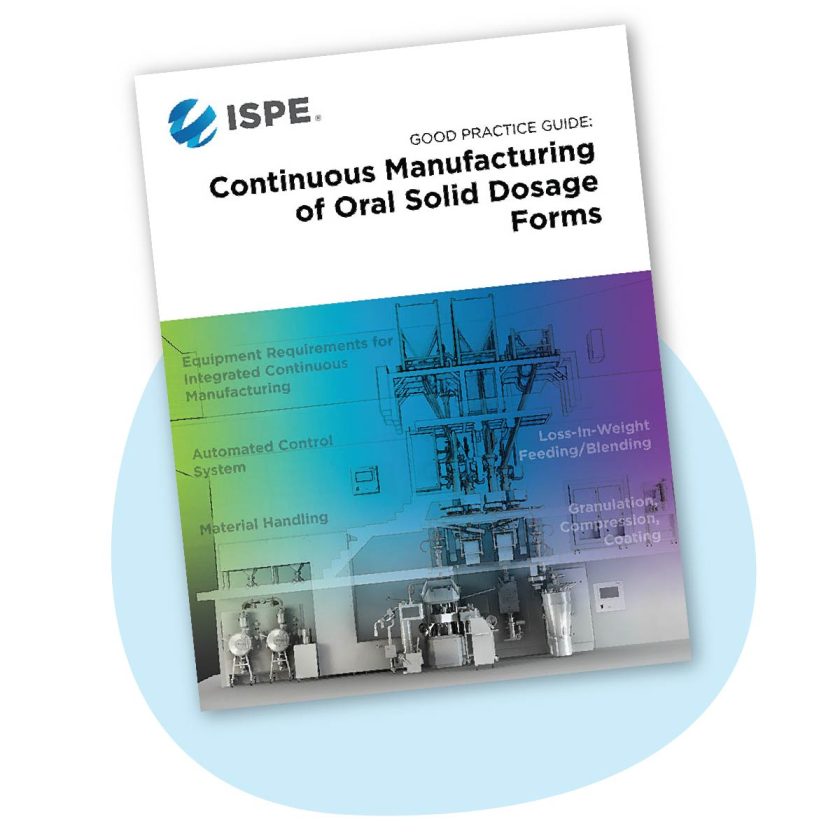
The answers are now clear, thanks to manufacturers who have established successful precedents for across formulation, equipment, automation, and process control. The International Society for Pharmaceutical Engineering (ISPE) reflects this progress in its 2022 publication, Good Practice Guide: Continuous Manufacturing of Oral Solid Dosage Forms, which lays out the unit operations commonly used in continuous manufacturing and defines minimum equipment requirements. Owners can consult this document for best practices in automation control and process analytical technology (PAT) measurements, helping them standardize their continuous systems and move more efficiently from design through integration, validation, and operation.
The regulatory pathway is now well defined
Alongside its evolution as a proven technology, continuous manufacturing has also gained traction with regulators. In 2023, the Food and Drug Administration (FDA) and the International Council for Harmonisation released Q13 Continuous Manufacturing of Drug Substances and Drug Products Guidance for Industry, which identifies scientific and regulatory considerations for developing, implementing, operating, and managing these processes across product lifecycles. The following year, the FDA published Advanced Manufacturing Technologies Designation Program Guidance for Industry, further defining a regulatory pathway for early adopters of CM and other technologies that improve manufacturing reliability, product quality, development timelines, and supply robustness. Today’s regulators clearly understand and value this approach in pharmaceutical manufacturing, provided it’s backed by a scientifically sound and operationally practical control strategy tailored to specific products, processes, and lifecycles.
From “Can we?” to “Should we?”
Despite the maturing technological and regulatory framework around this technology, it is not a universal solution for OSD manufacturers. Batch manufacturing remains viable, familiar, and widely available; moving to a continuous manufacturing platform makes sense only when the added value warrants such a transition.
Depending on the starting point, that transition may be challenging. Standing up a CM system typically involves significant organizational change, deeper control strategy maturity supported by deep automation and digital infrastructure, and a reliable long-term operating model. Owners may find it hard to justify the time and cost of meeting these requirements, especially given the “non-obvious” value of this technology. It doesn’t transform the final dosage; a pill is a pill, whether it came from a continuous manufacturing facility or not. The potential benefits relate to product lifecycle, quality, speed, and facility utilization that the patient will never see. For some owners, those benefits may not outweigh the investment required to access them.
Because of these considerations, owners are no longer asking, “Should we embrace continuous manufacturing?” Instead, the question has evolved into:
“What problem are we facing, and is there a role for continuous manufacturing in the solution?”
The continuous manufacturing spectrum
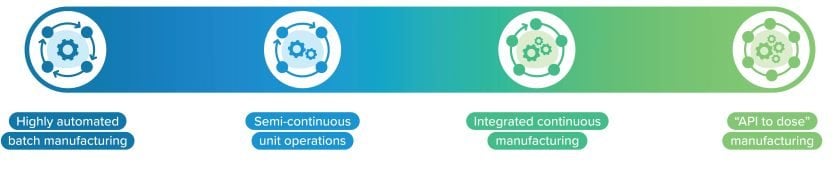
The answer to the latter question is rarely a binary “yes” or “no,” because the choice between continuous and batch manufacturing itself isn’t binary. In practice, CM can take many forms, including a hybrid role alongside more traditional production systems. This makes the decision about more than simply “buying a line.” It’s about the potential benefits and tradeoffs that are present at each point along the spectrum of applications.

Highly automated batch manufacturing
Modernized batch manufacturing can look very similar to a continuous system. Both approaches rely on many of the same control concepts, with material and data moving automatically from one step to the next.
The distinction comes down to the scale of scrutiny: a modernized batch system may look continuous from a higher-level automation perspective, but it still moves material through a series of discrete small batches.

Partially integrated or hybrid/semi-continuous unit operations
In this scenario, continuous manufacturing happens selectively rather than across the full process train. For example, a manufacturer may use continuous manufacturing from powder feeding through compression while retaining a batch system for bulk handling, coating, and packaging.
For owners solving a specific capacity, containment, quality, or material handling problem, leveraging a partial CM approach without committing to a fully integrated continuous line may be a pragmatic way forward.

Integrated continuous manufacturing
A fully integrated continuous OSD platform operates just as it sounds: as a single process train made up of multiple linked unit operations. Depending on the process, that train may include powder feeding, blending or granulation, compression, tablet testing, coating, and final dose collection, with automation and process controls coordinating how material moves between operations.
For owners whose volume, development timeline, and quality strategy align with the capabilities of this approach, this level of integration may make sense.

“API to dose” manufacturing
This approach is the fullest expression of small-molecule CM, linking active pharmaceutical ingredient (API) production directly to final OSD manufacturing through a continuous, end-to-end system.
This approach introduces new complexities during development. Traditionally, drug substance and drug product teams operate in silos; to make integrated API-to-dose manufacturing possible, these teams need to work much more collaboratively, potentially making decisions about drug product manufacturing before fully finalizing drug substance development. This degree of overlap isn’t unusual in itself, but managing it within an integrated system can challenge traditional development timelines and ways of working.
This approach also requires significant capital, particularly for owners reluctant to sacrifice operational flexibility (more on that below). As a result, it remains relatively uncommon, with few real-world examples operating today.
“Mini batches”: Blurring the line between batch and continuous
In “mini batch” manufacturing, automated feeders supply very small blenders, which then repeatedly discharge into downstream equipment such as a tablet press. Although this system is technically moving individual batches, the overall operation follows a near-continuous rhythm, creating an application for this approach that is suitable for both small production quantities and larger-volume manufacturing.
What should owners consider before committing?
To decide whether (and where) their operation belongs on the spectrum of available approaches, owners need to work through a combination of product, operational, facility, and lifecycle considerations, each with its own potential impact on the broader business plan. Often, that decision broadly hinges on three key questions:
- Is the product formulation a good fit for continuous processing?
- Where is the product in its lifecycle?
- What are we ultimately trying to optimize?
Formulation strategy can make or break the continuous manufacturing decision
Not every formulation suits the nature of certain continuous operations. Continuous blending, for example, relies on precise metering to control each ingredient’s proportion. The more ingredients involved in a formulation, the more complex (and costly) that metering requirement becomes. As a result, the economics of continuously blending a 27-ingredient vitamin formulation may be much harder to justify than those of an OSD formulation with just six components.
Formulation strategy, therefore, is an important part of the decision. When developing a new product, project teams may choose to optimize for a continuous manufacturing approach from day one. Simplifying an existing product, such as a recently off-patent generic, is much harder; reformulation may add research and development (R&D) and regulatory burden, potentially eroding the business case for moving that product to CM in the first place. Manufacturers standing up a system for an existing product may choose a traditional batch approach as the more effective path forward.
The value proposition may change across the product lifecycle
The business case for this approach can look very different depending on a product’s position in the development pipeline.

Development-to-launch: When scaling a batch process for commercial launch, manufacturers typically need to transfer their process from benchtop equipment to larger-scale vessels, introducing new process conditions and scale-up risks. CM offers an alternative: instead of increasing equipment size, manufacturers can move from small initial volumes to large-scale commercial production by simply extending run times on the same platform. This allows for a more nimble response to post-launch fluctuations in demand.
These potential scale-up advantages come with important trade-offs. For example, when developing on a continuous platform, R&D teams may require relatively large quantities of API at a stage when that material is hard to find and costly to acquire. In other words, choosing to leverage CM because of its scale-up advantages may create a significant material and cost burden in early development.

Commercial operations: At commercial scale, CM provides an opportunity to collect and utilize an extensive manufacturing dataset. Because the process operates continuously, a product’s true “process signature” becomes clearer, giving owners visibility into what normal performance looks like, where trends are emerging, and how changes in materials or process conditions play out across the production train. This rich data ecosystem supports tighter process control and real-time (or near-real-time) quality monitoring, as well as increased facility utilization.
To take advantage of these benefits, though, owners need a well-developed digital infrastructure that can support continuous manufacturing. We’ll explore the challenge of establishing this infrastructure later in this article.

Lifecycle management: The benefits of CM can extend far beyond launch. A well-designed continuous platform contributes to a stronger process knowledge base over time, giving owners more data to manage change and support ongoing improvement. This is why control strategy development is such a vital part of continuous OSD systems: the goal is not only to bring a continuous process online, but to establish a framework that supports ongoing lifecycle management.
Business priorities help shape the right continuous manufacturing approach
Even when the product characteristics and lifecycle considerations point toward CM as a viable strategy, owners still need to assess the way forward through the lens of their unique conditions of satisfaction. These priorities can push a project toward very different points on the manufacturing spectrum. For example:
Payback model: Continuous manufacturing can reduce operating costs, but that benefit only pays off once the system is online. Reaching that point—and doing it on a compressed timeline, within fixed CapEx constraints—can be difficult in practice. Without extensive early planning, owners may face delays caused by long equipment lead times, complex system integration challenges, and extensive validation requirements. Owners need to evaluate each of these factors to truly understand how quickly they can bring the system online, and whether that timeline is justifiable.
Flexibility: Some owners prioritize efficiency and deep optimization. This is often the case for those with mature, high-volume products and well-understood processes. For them, locking in key decisions early in the design process may not be a problem; they’re comfortable committing to a system purpose-built for specific and predictable parameters.
Others value flexibility more. This is often true for owners with evolving product portfolios, uncertain demand, or processes that are still maturing and may change in the future. Locking into a highly integrated system too early could set them up for costly changes later, negating the OpEx benefits of a CM system. For these owners, sacrificing potential efficiencies in exchange for greater flexibility may be the better long-term tradeoff.
Pharmaceuticals, nutraceuticals, and dietary supplements: Different sectors, shared lessons
High-throughput sectors such as nutraceuticals and dietary supplements have reasons of their own to adopt continuous or semi-continuous OSD manufacturing. They typically produce high annual volumes and face significant cost pressures; continuous manufacturing offers a viable pathway to meet those demands by reducing labor, handling, rework, and facility footprint.
These manufacturers may operate in a different regulatory context than pharmaceutical OSD owners, but they face many of the same underlying process and engineering challenges: feed consistency, segregation risk, blend uniformity, dust control, tablet quality, traceability, and more. This creates a useful cross-sector learning opportunity.
- Pharmaceutical manufacturers bring deep experience in regulatory defensibility, PAT, residence time distribution, diversion logic, and lifecycle control strategies.
- Nutraceutical and dietary supplement manufacturers bring practical experience with throughput, uptime, changeovers, cost control, and day-to-day operations at commercial scale.
The strongest project teams are fluent in both contexts, combining regulatory rigor with practical experience in high-volume production.
Integration is the hardest part
In the early years of continuous manufacturing, many expected that technology would drive digital transformation in OSD facilities. In reality, the relationship often works the other way around: manufacturers need a robust digital ecosystem in place first, which in turn supports successful adoption. This is one of the clearest differentiators separating continuous and batch manufacturing: for CM to work, the equipment must operate in unison, with automation, software, data handling, and process monitoring orchestrated across the system.
That’s why a CM project is more than a decision about process equipment. It’s also an Industry 4.0 modernization effort. In pharmaceutical applications, it requires a tightly orchestrated control strategy enabled by PAT capabilities and deep automation. These are not optional accessories; they’re central to successful implementation, providing the real-time visibility and control needed to manage such critical factors as:
- Feeder performance
- Residence time distribution
- Blender dynamics
- Process disturbances
- Diversion logic
- Material traceability
- Data integrity
- PAT model lifecycle
- Alarm response
- Operator interaction
To unlock this level of control, manufacturers must build digital capabilities into the manufacturing strategy from the outset.
Equipment vendors are taking on more of the integration burden
When continuous manufacturing was just emerging, early adopters had to connect individual pieces of equipment to their automation and data infrastructure at the site. This complex undertaking often added significant time, cost, and risk to implementation projects.
As the technology has matured, today’s OEMs are taking on more of that burden themselves, providing owners with pre-integrated or modular systems featuring equipment, controls, and data-handling capabilities designed to work together from day one. The result isn’t quite a “plug-and-play” manufacturing system, but it’s a leap forward, helping owners reduce their own integration effort.
Operational readiness alongside digital infrastructure
Even with the right digital infrastructure in place, owners need to consider other factors that contribute to successful integration. Those factors include designing a facility and material handling strategy to support a continuous system rather than work against it, and defining from the outset how the facility’s workforce will operate, maintain, investigate, validate, and support the system over time.
Cleaning and changeover are particularly important considerations. To turn over a continuous line, operators may need to break down and clean multiple connected systems, potentially increasing labor demand at specific points in the operating cycle. On the other hand, fewer operators may be required during routine production, since a continuous manufacturing system reduces the need to start, stop, and individually monitor unit operations. This can reduce staffing needs, although the remaining team may require deeper expertise in automation and real-time process control. As a result, workforce costs may rise despite reduced headcount.

Skilled labor constraints raise the stakes
In CRB’s Q3 2026 Horizons: Market Conditions update, we reported that nearly 80% of life science manufacturers identify skilled labor as a top-three concern when choosing where to build a new facility.
This constraint matters to manufacturers considering a move to CM, which could increase their need for workers with expertise in automation, process control, and validation. Given the competitive labor market, owners should plan for these needs early and build workforce availability and training into their CM business case from day one.
The bottom line: Continuous manufacturing is more than a technology choice
With a full CM system in place, it’s conceivable that an OSD manufacturer could move from receiving raw materials to distributing finished products within 24 to 48 hours. But as we’ve seen, that possibility does not make CM the right choice for every product or every manufacturer. Realizing its full value takes discipline and experience; it requires matching the right technology to the right product, developing a defensible control strategy, and designing facilities that can support reliable long-term operation, no matter the manufacturing model. These are not limitations of CM; they are reminders that it succeeds only when the broader business case supports it.
Ultimately, the goal should be a more reliable, responsive supply of high-quality OSD therapies to patients. For some owners, achieving that vision may involve a degree of continuous manufacturing. For others, a modernized batch-based system may be the better fit.
Wherever you are in that decision-making process, reach out to our continuous manufacturing experts. We can help your team turn the potential of CM into a strategy that fits your unique products, operations, and business priorities.
Frequently Asked Questions
Continuous manufacturing (CM) in oral solid dosage (OSD) production feeds raw materials in and collects finished product at the same time. Material flows through a linked train of unit operations instead of moving in discrete, start-stop batches. Depending on the process, that train can include powder feeding, blending or granulation, compression, tablet testing, coating, and final dose collection, with automation and process controls coordinating how material moves between steps.
The technology is no longer experimental. The early questions have been answered by manufacturers with commercial success stories: whether feeders could meter powders accurately enough, whether a continuous blender could maintain content uniformity, and whether a system could detect and reject disturbances. ISPE’s 2022 Good Practice Guide: Continuous Manufacturing of Oral Solid Dosage Forms now defines the common unit operations and minimum equipment requirements.
In practice, CM isn’t a single configuration. It ranges from partially integrated lines to fully integrated platforms. A partial line might run continuously from powder feeding through compression and keep coating and packaging as batch steps. At the far end are “API to dose” systems that link drug substance production directly to tablet manufacturing.
Takeaway: Think of CM as a spectrum of process designs, not a single piece of equipment. The right point on that spectrum depends on your product, volumes, and business goals.
The core difference is how material moves. Batch manufacturing processes a fixed quantity through each step and stops between operations. Continuous manufacturing keeps material flowing through connected unit operations as one coordinated process train.
In real facilities, the line is blurrier. A highly automated batch facility can look continuous from a high-level automation view, with material and data moving automatically from step to step, but it still processes material as a series of discrete small batches. “Mini batch” systems blur it further: automated feeders supply very small blenders that repeatedly discharge into a tablet press, creating a near-continuous rhythm.
Key practical differences include:
- Scale-up: Batch processes scale by moving to larger vessels. CM scales by running longer on the same platform.
- Data: CM produces a continuous dataset that reveals a product’s “process signature” and supports real-time quality monitoring.
- Integration: CM equipment must run in unison, so automation, PAT, and data handling are central rather than optional.
- Familiarity: Batch remains viable, familiar, and widely available.
Takeaway: The choice isn’t binary. Many owners land on hybrid or semi-continuous designs that use CM only where it solves a specific capacity, quality, or material handling problem.
The main benefits of continuous manufacturing for OSD are smaller facilities, easier scale-up, lower work-in-process inventory, tighter process control, and faster throughput. Together, these can help deliver high-quality therapies to patients more reliably.
- Simpler scale-up: Go from small initial volumes to commercial production by running longer on the same platform instead of transferring to larger vessels. This lets you respond faster to demand swings after launch.
- Richer process data: Continuous operation reveals a product’s true “process signature,” which supports real-time or near-real-time quality monitoring and better facility utilization.
- Stronger lifecycle management: A well-designed platform builds a deeper process knowledge base over time, which makes managing change and improving the process easier.
- Speed: With a full CM system in place, an OSD manufacturer could move from receiving raw materials to distributing finished product within 24 to 48 hours.
- Lower operating costs: CM can reduce labor, handling, rework, and facility footprint, which matters most in high-volume sectors like nutraceuticals and dietary supplements.
The catch is that these benefits are “non-obvious.” A pill is a pill: patients never see the gains in lifecycle, quality, speed, or utilization.
Takeaway: Quantify these benefits against the investment in automation, digital infrastructure, and organizational change before you commit.
No. Continuous manufacturing isn’t a universal solution, and for many OSD products a modernized batch process is the better fit. The decision usually comes down to three questions: Is the formulation a good fit for continuous processing? Where is the product in its lifecycle? What are we ultimately trying to optimize?
Formulation is often decisive. Continuous blending depends on precise metering of each ingredient, so complexity and cost climb with ingredient count. For example, continuously blending a 27-ingredient vitamin formulation is much harder to justify economically than blending a six-component OSD formulation.
Product status matters too. New products can be designed for CM from day one. Reformulating an existing product, such as a recently off-patent generic, can add R&D and regulatory burden that erodes the business case.
Business priorities also shape the answer:
- Owners with mature, high-volume products and well-understood processes may welcome a purpose-built, highly optimized CM line.
- Owners with evolving portfolios, uncertain demand, or maturing processes may value flexibility more. Locking into an integrated system too early could lead to costly changes later.
Takeaway: Start with the problem you’re solving. Then weigh formulation, lifecycle stage, and flexibility needs to find your place on the CM spectrum.
OSD manufacturers use a range of continuous manufacturing approaches, from highly automated batch systems to fully integrated “API to dose” lines. The main options are:
- Highly automated batch manufacturing: Uses many of the same control concepts as CM, with material and data moving automatically between steps, but still processes discrete small batches.
- Hybrid or semi-continuous: CM used selectively. For example, a line might run continuously from powder feeding through compression and keep batch steps for bulk handling, coating, and packaging. It’s a practical choice for solving a specific capacity, containment, quality, or material handling problem.
- Integrated continuous manufacturing: A single process train that links feeding, blending or granulation, compression, tablet testing, coating, and dose collection under coordinated automation. It fits best when volume, development timeline, and quality strategy line up.
- “API to dose”: The fullest form of small-molecule CM, linking API production directly to final OSD manufacturing. It needs close collaboration between drug substance and drug product teams, plus significant capital, so few real-world examples exist today.
There’s also “mini batch” manufacturing, where automated feeders supply very small blenders that repeatedly discharge into a tablet press. It’s technically batch, but its near-continuous rhythm works for both small and large volumes.
Takeaway: Choose a configuration based on the specific problem you need to solve, not on how “continuous” the system is.