published & featured news icon - talking bubble

CRB releases new Horizons: Life Sciences report

Oct 6, 2026

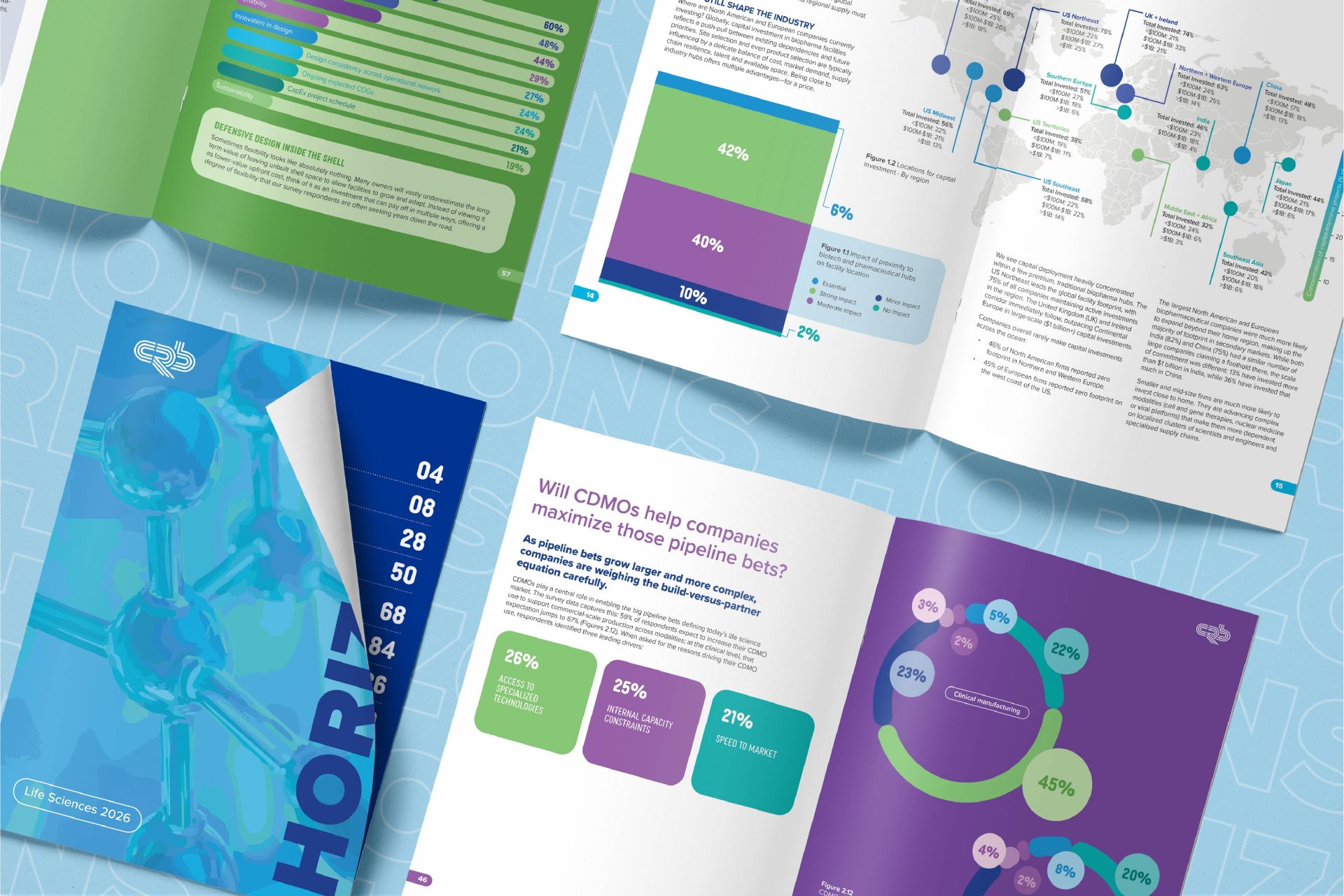
As AI usage takes shape and market pressures persist, CRB’s Horizons: Life Sciences 2026 report explores how manufacturers are investing in facilities, advanced technologies and workforce development

CRB’s newly released Horizons: Life Sciences 2026 report finds manufacturers expanding their pipelines, investing in advanced technologies, and committing to future capacity despite regulatory challenges, geopolitical pressures and rising costs.

Now in its sixth year, the report captures insights from more than 400 global industry leaders examining the trends, opportunities and challenges shaping the life science industry through four key lenses: industry outlook, pipeline growth, process innovation and the evolving relationship between people and technology.

The 2026 Horizons: Life Sciences report points to a clear trend: uncertainty hasn’t stopped life science companies from betting on growth.

“The data shows an industry that is willing to move forward despite supply chain hurdles and the rising costs of getting therapies to patients quickly and safely. Companies are investing in facilities, expanding into new modalities, adopting advanced technologies and developing new workforce strategies. The organizations that succeed will be the ones that can stay agile while building for the long term.” – Peter Walters, Fellow, Advanced Therapies

Among the report’s key findings:

  • 98% of respondents say proximity to established biopharmaceutical hubs influences facility location decisions, while 78% cite access to a skilled workforce as a top factor, highlighting the growing importance of workforce readiness in future investment strategies.
  • 68% expect AI, robotics and automation to reduce manufacturing cost of goods (COGs), signaling increasing confidence in advanced technologies as tools for improving operational efficiency and competitiveness.
  • 43% of respondents report having no formal plans to implement AI in regulated manufacturing environments, reflecting a persistent trust gap even as enthusiasm for AI grows elsewhere in the industry. These results suggest that human-in-the-loop approaches, which combine AI capabilities with human oversight, may be key to broader adoption in highly regulated settings.

Perhaps the clearest signal from this year’s data is the industry’s commitment to growth and diversification: every modality tracked in the survey showed increased manufacturing interest compared to 2025. From peptides and therapeutic proteins to cell and gene therapies and ADCs, companies are continuing to expand investments across a broad range of technologies and treatment areas despite an uncertain operating environment.

“Big pharma is working to absorb the demand shock in peptides and proteins with substantial investments in large-scale manufacturing facilities, but capacity expansion alone won’t be enough. To stay competitive, manufacturers need facilities that revisit production and find significant ways to reduce overall cost of goods.” – Christa Myers, Senior Fellow, Aseptic and Sterile Products

Looking ahead, the report suggests several trends are likely to shape the industry’s trajectory in 2027 and beyond. Among them: workforce availability becoming as influential as geography in site selection decisions, raising regulatory confidence through the adoption of human-in-the-loop AI models, renewed focus on manufacturing efficiency to improve affordability and patient access, and the continued commercialization of advanced therapies at scale. CRB’s data suggests that organizations that build trust, governance and workforce readiness alongside technology investments may be best positioned to capture the next evolution of technological value.

Horizons: Life Sciences 2026

download today

Backed by insights from more than 400 global R&D and manufacturing leaders, the Horizons: Life Sciences 2026 report reveals how the industry is committing capital, expanding into emerging modalities, and rethinking the skilled workforce to keep innovation moving forward — even without a surefire roadmap.